
Our Responsibility, Not Our Children's: Another Reason We Downsized
A much more personal reason behind our downsizing
DOWNSIZING & TRAVEL LIFE
8/10/20267 min read


Now that we have downsized and reduced our responsibility to “stuff,” we are able to travel more and visit our children without worrying about our house sitting empty, the lawn becoming overgrown, maintenance needing to be done, or any of the myriad things we had to think about as homeowners whenever we went on a trip or “vacation.”
Although this was one of the main reasons for our change in lifestyle, it certainly wasn’t the only one.
This next reason is a very difficult subject to write about. Often, as humans, we know it is coming, but we don’t want to think about it or face it.
It is the inevitability of death.
This is one aspect of downsizing we have thought about quite a bit. When we die—whether suddenly together, separately, after a prolonged illness, or because of an unexpected accident—the reality is the same. At some point, we must leave this Earth, and we cannot take anything with us.
The question for us isn’t, “What will become of us?” That is in the realm of our faith.
The question is: What will we leave for our children? What will THEY have to deal with?
Regardless of whether there is a will or a trust, someone still has to deal with all of our worldly business. And the odds are, it will be our children. My siblings are close to my age. They don’t live near us. Other relatives are far away, and this is not a burden we want to leave to our friends.
Ultimately, it will be our children—or strangers handling what we failed to take care of ourselves.
Think About What We Would Be Asking of Them
Our children are in their mid-20s. They are still in university, working toward the education they need to begin their careers.
They have jobs, but not yet the kinds of established careers where they have a great deal of flexibility. They are entry-level employees working for supervisors and companies that may have little ability—or willingness—to accommodate a major family emergency.
They also currently live abroad.
If something happened to us now, they would need to travel home, at considerable expense. They would need to deal with our burial arrangements, regardless of how simple we tried to make them, from cremation to a traditional burial. We can leave detailed instructions explaining what we want, but someone still has to handle the physical details.
And on top of all of that is something much bigger: the emotional burden of loss.
No one knows the future. We are only promised the present. We can reflect on what happened in our past and use what we learned to reduce and organize as many aspects of our eventual exit as possible—while we are still here and able to do it ourselves.
What Happened in Our Past?
For much of the last 30 years, my husband and I cared for and oversaw many aspects of his mother’s life.
She passed away at 93 after a very brief illness that was exacerbated by other physical issues. In other words, we knew the end would eventually come, but nevertheless, it came more quickly than we expected.
Fortunately, she did arrange a prepaid burial plan, and we had clear instructions about how she wanted her end-of-life arrangements handled. She also lived close to us, and we were well into our 50s with established careers that allowed us to take time off to handle the details. Her planning reduced the number of difficult decisions we had to make during an already emotional time. Death, after all, never comes at a convenient time.
But there was one thing she didn’t do.
She didn’t downsize her possessions.
We would ask her to go through her “boxes” of stuff, and we offered to help. Her response was usually some version of:
“I have to go through those boxes. I’ll do it later.”
Over her lifetime, she accumulated nearly 90 years’ worth of possessions.
When we moved her from the house where she had lived 40 of her 90+ years, 400 miles away from us, she did have to reduce what she owned and leave much behind. Her children physically moved her and her belongings closer to us. Much of it went into storage until she got settled, and then we moved her again into a senior living apartment.
She was 62 years old then.
For the next 30 years, much of what she brought with her—and what she continued to accumulate—remained in boxes in her apartment, waiting for someone to eventually clean it up.
That someone was William, her son.
My own family had a similar experience, but with considerably more struggle.
My mom had already purchased a burial plot next to my father, who passed away before her. But whenever we spoke to her about making the rest of her burial arrangements in advance, she was adamant that she didn't need to do it “yet” because she stated, "I'm going to live to be 123 years old".
Interestingly enough—whether coincidence or fate—she died on January 24: 1/24.
But while she was still mentally able to make these decisions for herself, she chose not to. Within four years, her memory began fading, and eventually her children had to make decisions she was no longer able to make.
My mom was ill for the last 10 years of her life. As her condition worsened, she became unable to care for herself. My brother moved in with her and eventually became her primary caregiver.
I remember visiting through the years before she became ill, and sitting with her for hours, trying to organize her “office.” Most of the time, we made little progress because she had plans to use the “stuff” later.
When my brother moved into her house, he brought his own possessions with him. He also had his own work, and caring for our mother became a full-time job in itself. He was reluctant to move her into a senior memory-care home, so his son and daughter helped when they could. But they too had jobs and lives of their own, and their schedules often conflicted. My siblings and I didn't live nearby and couldn't help our brother on a daily basis, so much of the responsibility fell on him.
We had many conversations about working together to make decisions regarding Mom's end-of-life business. But he wasn't ready to make those decisions either, so the plans continued to be postponed.
After our mom died, I thought we had some of the financial arrangements in place. Unfortunately, things didn't work out as I had understood they would, which caused considerable stress at an already emotional time.
That experience was particularly frustrating because I had already seen the alternative.
My mother-in-law had made her burial arrangements herself. When the time came, we didn't have to wonder what she wanted or make those decisions for her while we were grieving.
My mother's burial arrangements could have been made 10 years earlier, when she was still able to make those choices for herself.
Instead, the decisions eventually landed on her children.
And our family's story didn't end there.
Less than five years after our mom died, my brother died too. Tragically, his son had died in a motorcycle accident only six months earlier. When my nephew died, my brother purchased burial plots for both his son and himself. So at least that decision had already been made.
But once again, there were arrangements that need to be made and possessions that were left behind.
This time there wasn't just one person's lifetime of belongings. There were my mother's possessions, my brother's possessions and my nephew's possessions.
And ultimately, much of that responsibility landed on my brother's daughter.
Three generations of possessions and decisions had moved down to the next generation.
That is exactly the pattern we don't want to leave for our own children.
We Didn't Want to Repeat the Pattern
After living through these experiences, we decided we absolutely did not want to leave 40 years of possessions for our children to clean up.
It is our stuff. They shouldn’t have to be burdened with it.
They will already have plenty to deal with physically and emotionally when we die. Sorting through decades of things we simply never got around to dealing with should not have to be added to that list.
Of course, we hope we have another 30 years ahead of us. We hope we have plenty of time to continue organizing our lives and reducing the eventual impact on theirs.
But hope isn't a reason to wait.
That became one of the strongest reasons for us to downsize now, while we are healthy, strong-willed, clear-minded, and physically able to do the work ourselves.
And before we made many of our decisions about downsizing, we also made absolutely sure that neither of our children—or anyone else in our immediate family—wanted to live in our house or remain in the community where we lived.
If one of our children had wanted to return to the family home and raise a family there, perhaps our decision would have been different.
But even then, our “stuff” would still have needed to be organized and gone through.
And it would become their home, not a homage to us.
Ultimately, we have to be willing to face the fact that we aren't here on this Earth forever. Our children—and eventually their children—do not and should not have to bear the responsibility for the things we were unwilling to deal with ourselves.
Downsizing, for us, wasn't simply about owning less.
It was also about making sure the people we love have less to carry after we're gone.
Thinking About Your Own Downsizing Journey?
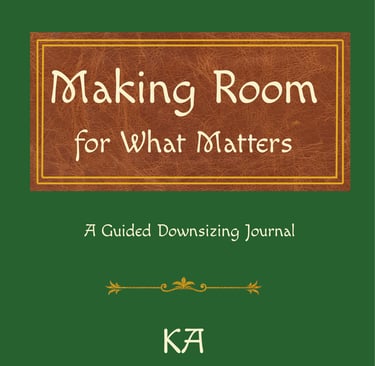
Maybe you're beginning to think about downsizing, or you've already started and aren't quite sure what comes next. Our free Making Room for What Matters: A Guided Downsizing Journal was created to help you slow down, reflect on where you are, and decide what moving forward might look like for you.
Download the free journal →

Kakkoii Adventures
A couple navigating life's changes, making intentional choices, and living the life made possible.
STAY ConnectED
© 2026 - All rights reserved.
Making room. Choosing what's next. Living the life those choices make possible.
Join us for our twice-monthly newsletter as we share the choices, changes, and adventures along the way.