
The Weird Museum for Boys and Girls
A Window into Japan's Strange Nostalgia
CULTURAL
6/28/20266 min read
The Weird Museum for Boys and Girls: A Window into Japan's Strange Nostalgia
With our stay in Atami coming to an end, my son and I decided on one last adventure—a spur-of-the-moment train ride farther down the Izu Peninsula to visit Mount Ōmuro.
Mount Ōmuro is a nearly perfect cone-shaped volcano near Itō that looks almost man-made. Standing 1,903 feet tall, it was formed by an eruption roughly 4,000 years ago, the same eruption that helped create the dramatic Jogasaki Coast nearby. A classic cinder cone volcano, it features a large circular crater at its summit and offers spectacular views of Mount Fuji and the surrounding valleys.
Visitors reach the summit by chairlift and can then walk completely around the crater rim. The panoramic views were impressive and well worth the trip. Unfortunately, we needed to make it back to the train station by 7:00 p.m., and time was beginning to slip away.
After walking the rim of the crater and riding the chairlift back down (which seemed scarier going down than it did going up) we headed to the parking lot to call a cab. While waiting for a taxi, my son remembered that the "Weird Museum for Boys and Girls," or Ayashii Shōnen Shōjo Hakubutsukan, was located nearby. Since we still had some time to spare, we decided to have the taxi drop us at the museum and walk back to the station afterward.
The museum is one of many unusual attractions scattered throughout the area. During Japan's economic boom of the 1970s through the 1990s, the Izu Peninsula became a major vacation destination for visitors from Tokyo and Yokohama. To attract tourists, entrepreneurs opened dozens of specialized museums devoted to everything from teddy bears and cats to music boxes, wax figures, and bizarre curiosities. Many of these private museums still survive today. The Weird Museum for Boys and Girls is one of the survivors.
This is reflected through pop culture with monsters, horror, fashion, toys, dolls, and countless other oddities gathered over many years.
In Japan, the terms shōnen (boy) and shōjo (girl) evoke a particular era of youth culture—old manga, school life, toys, fashion, and magazines. The museum's name suggests a journey into the strange and nostalgic world of Japanese childhood and adolescence, although many of the exhibits are clearly aimed at adults.
Established in 2006, the Weird Museum for Boys and Girls grew out of that environment. Rather than focusing on a single subject, it became a sprawling collection celebrating Shōwa-era Japan. The Shōwa period lasted from 1926 to 1989, corresponding to the reign of Emperor Hirohito, who is posthumously known as Emperor Shōwa. When people talk about "Shōwa nostalgia" today, they're usually referring to the 1950s through the early 1980s—a period remembered for tin and early plastic toys, retro manga and anime, the first generation of Japanese consumer electronics, and a slower-paced, more community-oriented way of life.
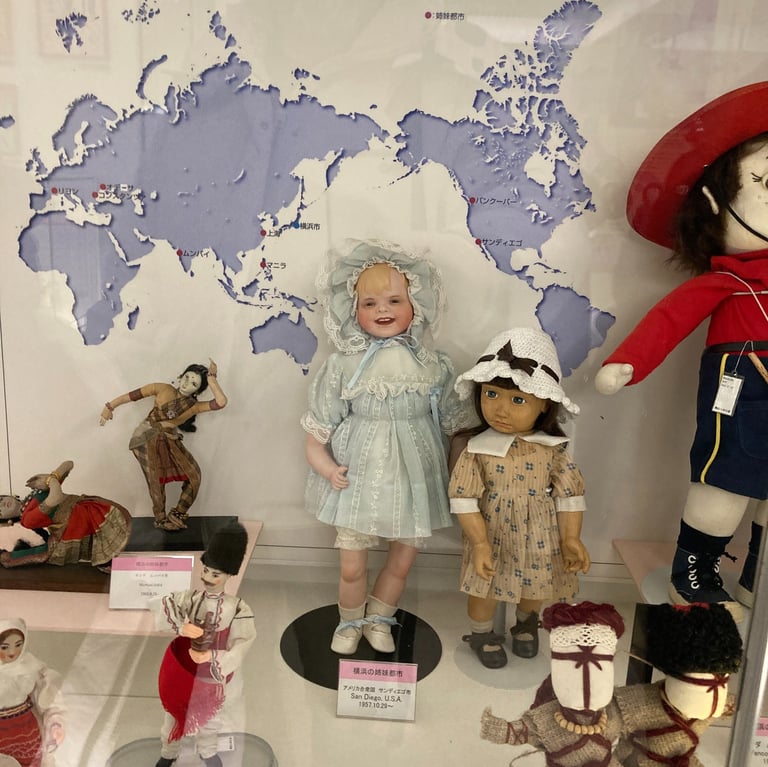
From the outside, the building appears neglected and almost forgotten, but that is part of its charm. It feels as though you have stumbled upon a hidden secret rather than a tourist attraction. Inside, the museum is delightfully chaotic. After paying our admission, we wandered through rooms packed with vintage toys, dolls, school uniforms, pop-culture memorabilia, monsters, and eerie mannequins.
Unlike a traditional museum organized around historical facts and timelines, this collection feels like stepping into the mind of a passionate collector determined to preserve the forgotten corners of Japanese culture. Every room presents a mixture of nostalgia and unease. More than once, it felt as if we were exploring someone's personal collection of treasured memories and strange fascinations that had simply grown too large to keep at home.
Childhood toys sit beside horror displays, while nostalgic schoolroom scenes blend seamlessly with monsters and supernatural imagery. The presentation reflects a distinctly Japanese idea that the past is never completely gone. Old dolls, abandoned schools, forgotten objects, and spirits coexist within the cultural imagination. As a result, walking through the museum can feel unsettling even when nothing is actively trying to scare you.
For many Japanese visitors, the museum evokes a feeling known as natsukashii—a nostalgic longing for the past. Here, however, that nostalgia is mixed with a subtle sense of unease. The museum is part time capsule, part ghost story, and part celebration of the Showa era.
What makes the Weird Museum for Boys and Girls memorable is not simply its collection of strange objects. Rather, it offers visitors a glimpse into a distinctly Japanese sensibility—one in which the past is never entirely gone. Old toys, forgotten fashions, ghost stories, and folklore coexist in a dreamlike space where nostalgia and mystery are inseparable. For anyone interested in Japanese culture, the museum is more than a curiosity. It is a window into how Japan remembers, imagines, and, at times, gently haunts itself.
In fact, the museum becomes much more interesting when viewed not as a collection of oddities, but as a cultural artifact in its own right. Collections like the Weird Museum for Boys and Girls tell us less about the individual objects than about what a society chooses to remember, and preserve.
Many of the objects in the museum come from the decades when Japan transformed from a recovering postwar nation into an economic powerhouse. The toys, school uniforms, magazines, and household items document a way of life that largely disappeared during rapid urbanization and modernization.
The museum suggests that many Japanese people feel a longing for that era—not because life was necessarily better, but because it was more familiar, communal, and understandable.
The emphasis on boys, girls, schools, toys, and youth culture reflects how central childhood memories are to Japanese nostalgia. The museum preserves not famous historical events but ordinary experiences: classrooms, cartoons, dolls, and playground culture.
In a sense, it treats everyday childhood as worthy of preservation.
In Western Societies we often draw a sharp distinction between folklore and modern life. Japan tends to be more comfortable allowing traditional spirits, monsters, and supernatural ideas to coexist alongside modern technology and consumer culture. The resurgence in interest in yokai since World War II would be an example.
The museum's blending of toys, yokai, ghosts, and pop culture suggests that folklore remains part of the cultural imagination rather than merely a historical curiosity.
One of the most striking aspects of the museum is its mixture of comfort and unease. Visitors encounter familiar childhood objects alongside eerie dolls, abandoned classrooms, and horror imagery.
That combination may reflect a broader social tension: modernization brought prosperity and convenience, but it also erased traditions, neighborhoods, and ways of life. The museum seems to ask whether something valuable was lost along the way.
Traditional museums often preserve kings, wars, masterpieces, and great achievements. This museum preserves plastic toys, school supplies, comic books, and advertisements. That choice reveals something important about Japanese historical consciousness. Everyday life is treated as culturally significant. The collection implies that understanding a society requires understanding how ordinary people lived, played, dreamed, and imagined. Perhaps most importantly, the museum is not really about toys or monsters. It is about memory.
The objects are reminders that the past is never completely gone. They evoke emotions, stories, fears, and desires that continue to shape the present. The museum's cluttered, almost dreamlike atmosphere mirrors the way memory itself works—not as a neat timeline, but as a collection of fragments, associations, and feelings.
For that reason, I would argue that the Weird Museum for Boys and Girls has genuine social relevance. It documents what official histories often overlook: the emotional life of a generation. By preserving the artifacts of everyday childhood, popular culture, folklore, and fear, it offers a window into how postwar Japan understood itself and how it continues to remember its past.
And that’s why the museum is interesting. The collection isn't valuable because the objects are rare. It's valuable because the collection reveals what people cared enough to save. And what a society chooses to save often tells us as much as what it chooses to forget.
We unfortunately did not have time for the haunted school attraction called "Night School" (Yoru no Gakkō). It's actually a separate building next to the museum rather than part of the main exhibit hall. Schools are a common setting for ghost stories and urban legends in Japan. Tales of haunted classrooms have been part of popular culture for decades. Entire books, films, manga, and television series have been built around the idea that schools become eerie places once the students have gone home.
With only twenty minutes left before our train departed, we reluctantly pointed ourselves toward the station instead of the haunted schoolhouse. As tempting as it was to squeeze in one more strange attraction, some experiences are better left for another visit. Travel is often as much about the things you don't see as the things you do. The Weird Museum for Boys and Girls had already given us plenty to think about—a curious blend of nostalgia, folklore, and the uncanny that seemed perfectly at home on the Izu Peninsula. As we hurried toward the station, I found myself glancing back one last time, wondering what other odd stories were hidden behind those weathered walls. Perhaps that's part of the museum's charm. Like the memories it celebrates, it leaves a few mysteries unresolved and a reason, however unlikely, to someday return.


If you enjoy Museums, here are a few more inspiring museums you may like!


Kakkoii Adventures
A couple navigating life's changes, making intentional choices, and living the life made possible.
STAY ConnectED
© 2026 - All rights reserved.
Making room. Choosing what's next. Living the life those choices make possible.
Join us for our twice-monthly newsletter as we share the choices, changes, and adventures along the way.