
Hachi-Oji Castle
The Interconnectedness of Japan (Odawara, Takiyama, Hachiōji)
2/28/20263 min read
The sense of historical connection across Japan is something we encountered again and again. Last spring, we attended the annual celebration at Odawara Castle, known as the Odawara Hōjō Godai Festival (小田原北條五代祭り). It is one of the largest historical festivals in Kanagawa Prefecture and commemorates the Hōjō clan, the regional rulers who governed Odawara for nearly one hundred years. The castle itself is strikingly beautiful, and the historical reenactments help visitors imagine the scale of the conflicts that once unfolded there.
Later that summer, we traveled to the remains of Takiyama Castle in Hachiōji. Although quieter and less famous, Takiyama was closely connected to Odawara. It formed part of a defensive network whose center lay to the south at Odawara Castle. Takiyama served as an outer shield, guarding the western mountain routes through which armies from central Japan might enter the Kantō Plain. If invasion came, resistance would begin in places like Takiyama, buying time for the main forces farther south.
Both Odawara and Takiyama were castles that once belonged to the Hōjō clan — which can feel a little confusing at first. You almost need a scorecard to keep track of the relationships.
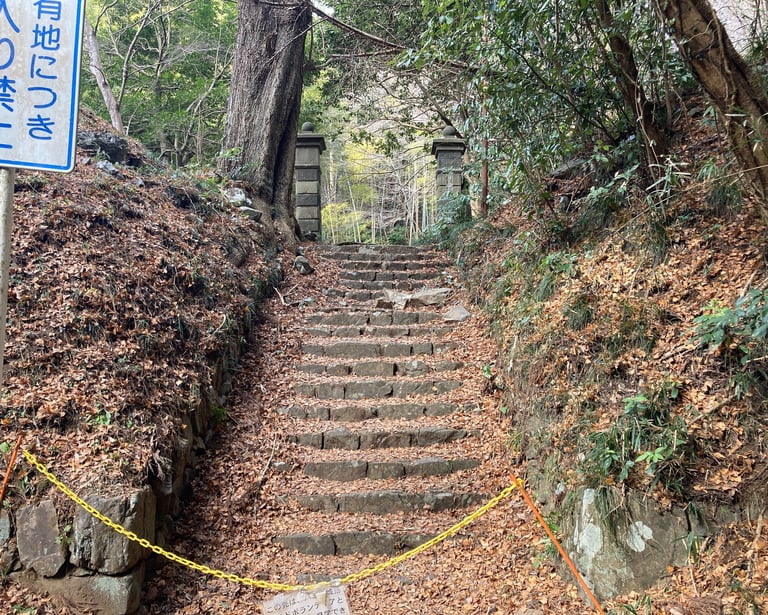
Odawara today is a magnificent reconstruction of the original castle. Takiyama, by contrast, exists in a state of quiet ruin. Very little of the built structures remain. Instead, the site reveals a different approach to historical preservation. Rather than reconstructing the castle, Japan preserves the landscape itself — the earthworks, ridgelines, and defensive terraces — allowing visitors to experience the physical shape of the past. Through virtual reconstructions viewed on smartphones, the missing gates and buildings briefly reappear, helping visitors imagine what once stood there.
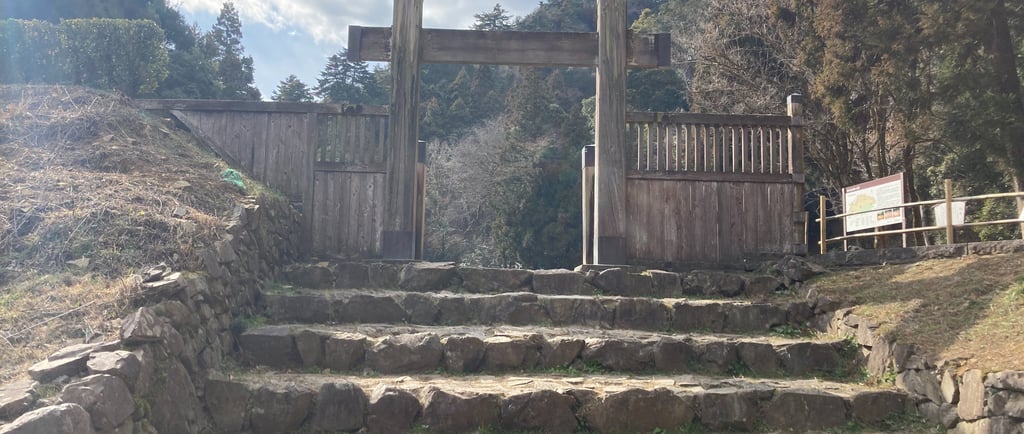
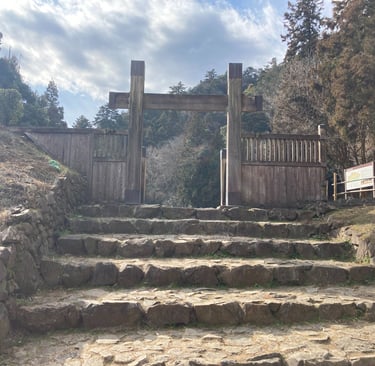
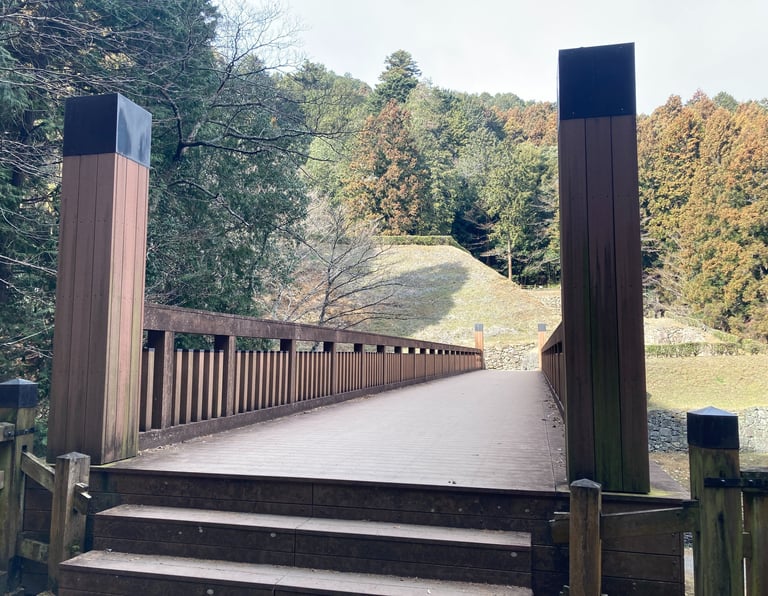
These two related castles are preserved in very different ways. A third approach, forming a kind of historical triad, is best exemplified by Hachiōji Castle. Here, the presentation is more park-like, occupying a middle ground between reconstruction and ruin. It is not rebuilt like Odawara, but neither is it left as untouched as Takiyama. Instead, the site is presented as an archaeological restoration landscape, where portions have been stabilized or partially reconstructed while the natural terrain remains intact.
Thus, three castles — all connected through the Hōjō clan — are preserved in three distinct ways. And that is what Mary and I had come to see.
As we approached, the surrounding farmland felt quiet and ordinary, yet it once stood at the edge of one of the most contested regions in eastern Japan. Walking through the grounds, we were reminded of a place many Americans would recognize — the Alamo.
The comparison is not exact in scale or history, but the emotional resonance feels similar. Both were fortified strongholds overwhelmed by superior forces. Both involved desperate fighting and heavy loss. And in both cases, the fall carried meaning far beyond the battlefield itself. At Hachiōji, the defenders faced Toyotomi Hideyoshi’s massive invasion army in 1590. The castle fell after intense fighting, and many who defended it died. Its loss signaled that the Hōjō clan’s regional power was collapsing, just as the fall of the Alamo foreshadowed the larger transformation unfolding in Texas.
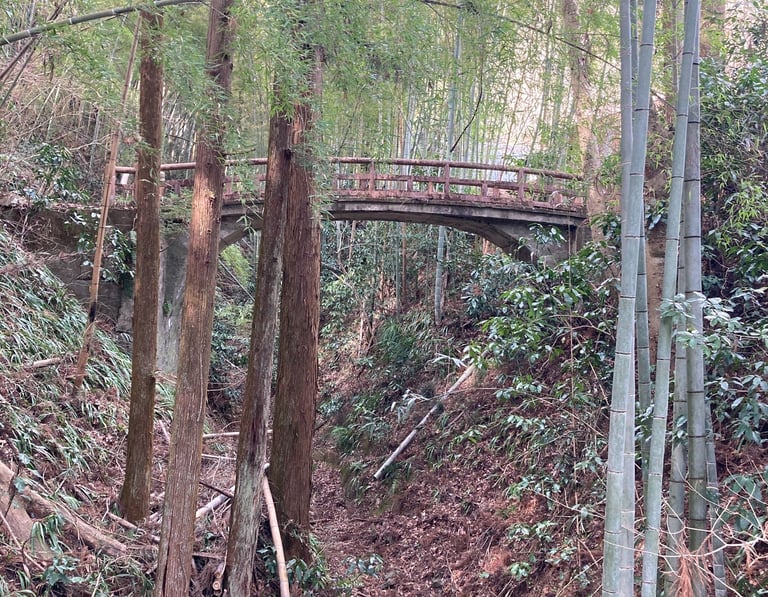
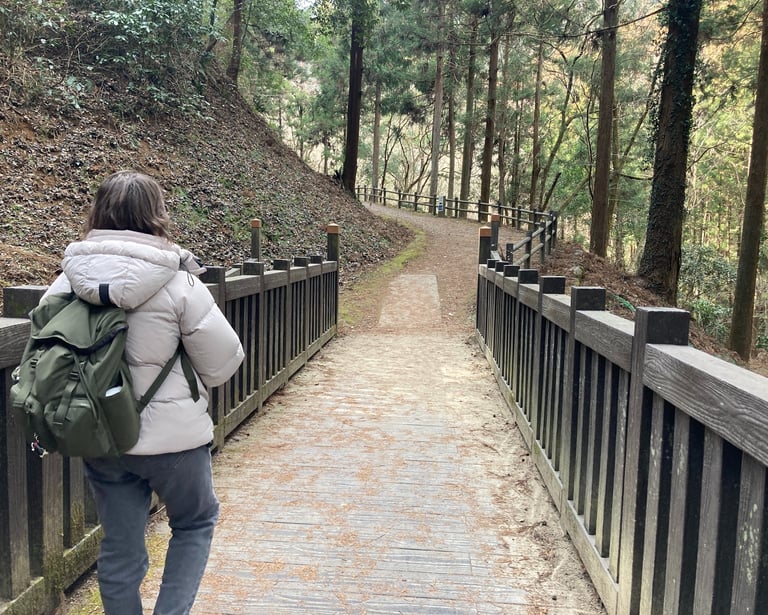
Yet what lingers most is not the battle itself, but the atmosphere. Today, Hachiōji feels calm, almost meditative. Trees cover the slopes where soldiers once stood guard. Paths wind through spaces that were once fortified defenses. The violence has long passed, but the memory remains embedded in the landscape. Like the Alamo, the site carries a quiet solemnity — a recognition that ordinary ground can hold extraordinary human struggle, sacrifice, and loss.
Standing there, it was easy for us to sense how history does not always announce itself loudly. Sometimes it survives in silence, in terrain, and in the stories we continue to tell.
In the end, what stayed with us was not simply the story of a fallen castle, but the realization that history in Japan often lives not in monuments, but in relationships — between places, between landscapes, and between moments separated by centuries. Odawara, Takiyama, and Hachiōji are bound together by the rise and fall of the Hōjō clan, yet each survives in a different form: reconstruction, ruin, and restoration. Standing there, we felt how power can vanish, how fortresses can dissolve into forest, and how entire political worlds can disappear almost overnight. And yet something remains. The ridgelines still guide the eye. The paths still follow defensive routes carved long ago. The land remembers. For us, that quiet persistence — more than any reenactment or reconstruction — was the most powerful connection of all.
Kakkoii Adventures
A couple navigating life's changes, making intentional choices, and living the life made possible.
STAY ConnectED
© 2026 - All rights reserved.
Making room. Choosing what's next. Living the life those choices make possible.
Join us for our twice-monthly newsletter as we share the choices, changes, and adventures along the way.