
Hida-Kanayama
Between Two Eras
1/7/20264 min read
Reaghan has discovered a new video game. It’s called Silent Hill f. It’s a survival horror game for PC in which the protagonist, Hinako, must solve puzzles and confront inner questions. As the title suggests, it is a horror game with a notable level of body horror.
The story is set in a fictional town named Ebisugaoka (戎ヶ丘). It’s a moody, dark setting, and it is based on a real town in Gifu Prefecture called Hida-Kanayama, located about 90–100 km (55–62 miles) outside of Nagoya. By train, the ride is approximately two hours from Gifu City, with a couple of transfers.
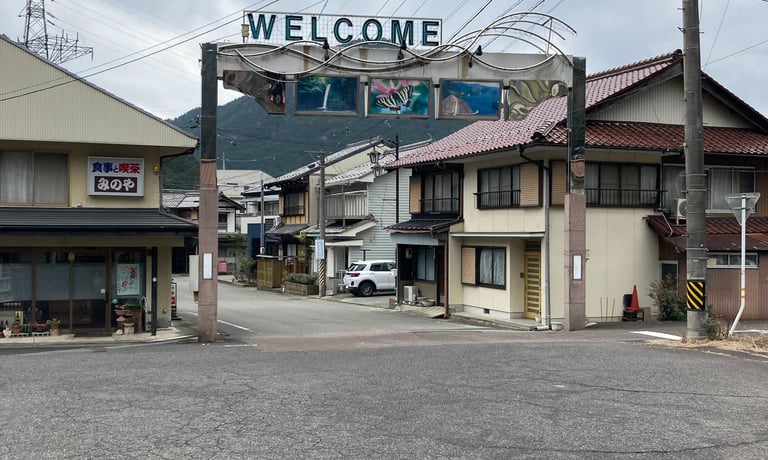
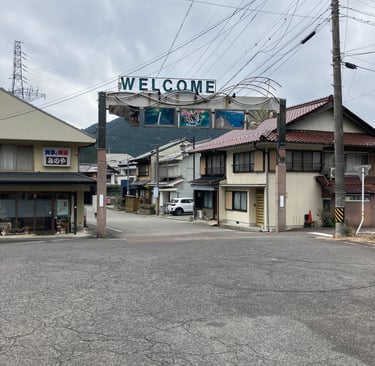
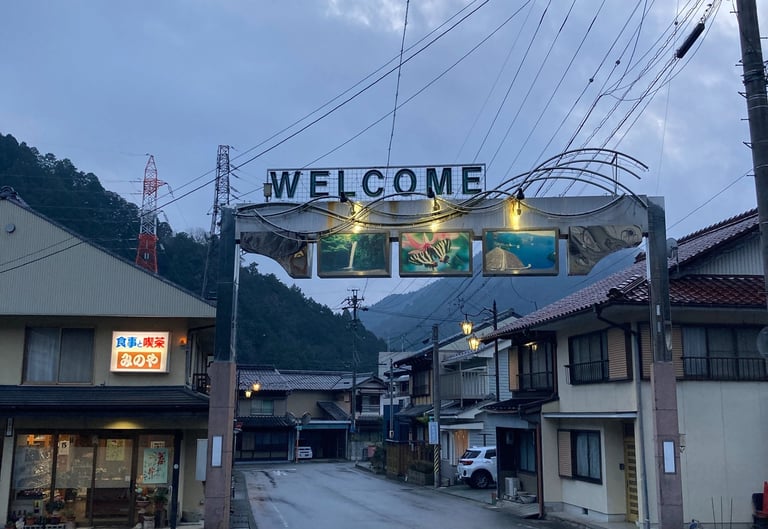
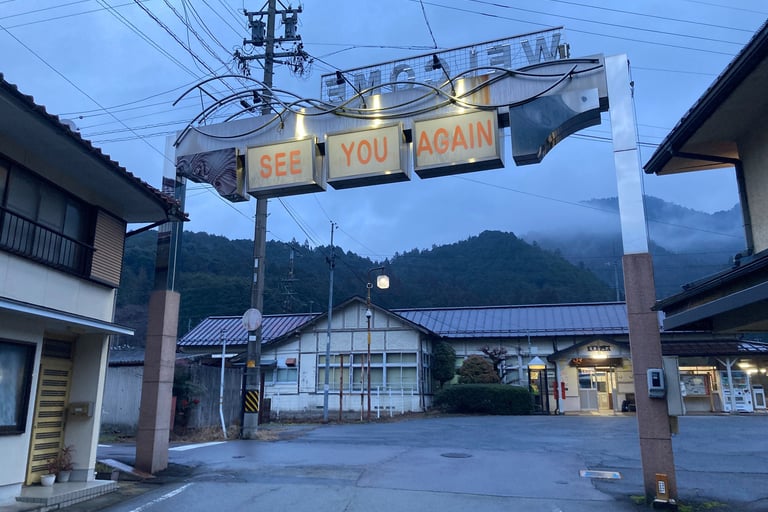
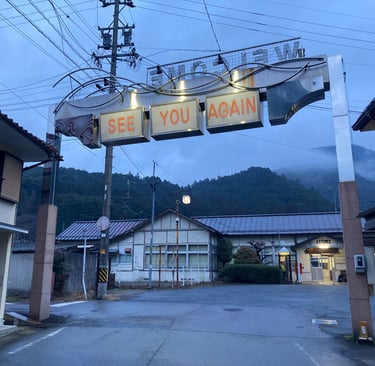
When the train arrives at the station, we are greeted by an enormous WELCOME sign outside Hida-Kanayama Station, and the first thing I notice is that it seems somewhat out of place. It’s not broken. It’s not neglected. It’s doing exactly what it was designed to do. Big letters. Cheerful confidence. English optimism stretched across a quiet street that doesn’t seem best suited for a zombie apocalypse movie.
The town is calm to the point of near invisibility—low buildings, muted colors, and few cars. There was a resident who appeared throughout the village using a mobility scooter. Nothing is trying to impress anyone.
The sign, on the other hand, is trying very hard.
That mismatch is what draws the eye. Not decay, not abandonment, but a kind of temporal dislocation. The sign feels like it was installed for an audience that never arrived. I was unable to find the exact date of its construction, but the approximation is 1982. It was an attempt to bring tourists to this former logging town in the mountains. The sign was written in English because the local council believed it would imply a more modern city.
It belongs to an era that believed visibility itself could secure the future—that if you declared WELCOME loudly enough, the city’s future would be successful.
Success never really came for Hida-Kanayama. It is known for some magnificent waterfalls and shrines, but this town was originally a working town.
Japan’s rural towns did not all decline in the same way, nor did they all respond to decline with equal success. Further along the same rail line lies the town of Takayama, which offers a particularly revealing contrast. Both towns faced similar postwar pressures: population loss, industrial contraction, and the hollowing out of station-front commercial streets. Yet Takayama emerged as a global tourism destination, while Hida-Kanayama settled into a quieter, unresolved existence.
The difference between them is not simply money, luck, or geography. Takayama learned how to curate its past; Kanayama was left holding the artifacts of a future that never fully arrived. And today, in an unexpected twist, that unresolved quality—once considered a failure—may represent Kanayama’s most valuable asset.
Takayama’s success is often described as inevitable, with its well-maintained Edo-period streets and carefully preserved festival floats. But Takayama’s transformation was not passive. It was an early, coordinated effort to translate local history into a legible experience for outsiders.
Takayama possessed several advantages: surviving merchant houses, dramatic annual festivals, walkable historic areas, and the fortune of existing in a geographic position along an emerging tourist corridor (Nagoya → Takayama → Shirakawa-go).
Takayama recognized early that heritage must be preserved without appearing artificial. Preservation ordinances regulated signage, architecture, and storefronts. Museums, sake breweries, craft shops, and ryokan all reinforced the same message: this is a place where the past is not only visible, but consumable.
By the time domestic tourism surged in the late Shōwa and early Heisei periods (1980s–early 1990s), Takayama was ready. When international tourism followed, the town was prepared with English signage, mapped walking routes, and curated “must-see” zones. Everything worked toward coherence.
Takayama became, in effect, a stage set for continuity—beautiful, authentic, but undeniably arranged.
Kanayama’s history follows a different arc. Rather than a preserved merchant town, it was a Shōwa-era working settlement, shaped by forestry, river control, rail transport, and regional industry. Its buildings were practical. Its streets were built for movement, not lingering. When modernization arrived, older layers were not preserved; they were replaced.
Kanayama did not develop the same sense of heritage. It consists of a railway station, wide streets, concrete buildings, and the enormous English WELCOME sign at the station entrance. It belongs to this era. It belongs to the belief that visibility alone would summon a successful future.
But when industries declined and young people left, Kanayama was left with no obvious story to sell. Unlike Takayama, it had nothing to curate. There were no streets preserved to fence off, no festivals with national recognition, no compact historic core to market.
The most striking thing about Kanayama today is not decay, but stasis. Much of Japan’s countryside has been aggressively rebranded, sanitized, or demolished. Kanayama has largely been left alone.
This creates a peculiar effect. The town feels out of sync, not ruined. Signage remains from earlier campaigns. Buildings persist without new purpose. The optimism embedded in infrastructure has not been overwritten by a new narrative.
To the residents, this is normal. To outsiders, there is a sense that the town is suspended between eras.
Modern Japanese horror, particularly in games and visual media, has shifted away from urban shock toward atmospheric unease: empty streets, shrines without visitors, towns that feel remembered rather than inhabited.
Silent Hill f draws heavily on this aesthetic—rural Japan, spiritual residue, and landscapes shaped by abandonment rather than destruction. While Kanayama is not officially named, the resemblance is unmistakable to those familiar with towns like it.
And I think this matters because Japanese horror fandom does not seek polish; rather, it seeks an authentic sense of unease. In contemporary culture, that feeling has value.
A place ignored by locals may gain value once outsiders notice it. When a town is photographed, written about, or referenced in global media it becomes eligible for protection, its atmosphere becomes its heritage. Stillness becomes intention.
Kanayama does not need to brand itself as a horror town. Doing so would cheapen it. Instead, it can quietly acknowledge what already exists: a place whose appearance resonates with contemporary cultural anxieties about memory, loss, and transition.
The WELCOME sign, once an embarrassment, becomes an artifact. A relic of optimism. A symbol of the gap between expectation and reality.
In an age increasingly drawn to liminality, Kanayama's honesty may prove more durable than Takayama's polish.
And in a cultural moment fascinated by ghosts, quiet towns, and futures that stalled mid-sentence, Kanayama may finally be speaking a language the world is ready to hear.
We didn’t spend nearly enough time in Kanayama, but we met some wonderful people and saw some signs that the town wasn’t finished yet. They’ve taken pride and ownership in their new found infamy and it may just be enough to save this last, preserved Showa era town that really deserves another try.
Kakkoii Adventures
A couple navigating life's changes, making intentional choices, and living the life made possible.
STAY ConnectED
© 2026 - All rights reserved.
Making room. Choosing what's next. Living the life those choices make possible.
Join us for our twice-monthly newsletter as we share the choices, changes, and adventures along the way.