
Leaving The Postcard
Leaving Highway 66 For Wickenburg
ARIZONA
4/8/20269 min read
Leaving the Postcard: An Arizona Road Essay
There is a point in every road trip when it stops being about where you intended to go and starts becoming about what kind of day the road is willing to give you.
That shift happened somewhere between the map and the morning.
At first, the trip had all the right nouns. It had shape. It had a line to follow: Laughlin to Kingman. Kingman to Seligman. Then eastward into the bones of old Arizona—Williams, maybe Winslow, maybe Show Low, maybe even farther if the road and mood held together. It looked like one of those drives that could be explained neatly later. A proper Southwestern loop. Route 66. Old motels. Dust. Railroad towns. The kind of trip people summarize in a few clean sentences as if they had known all along what they were doing.
But road trips rarely deserve that kind of editing.
The truth is that this one kept changing in real time, and maybe that was the point.
It began with the old dream of the American road—the version sold in signs, postcards, songs, and all the battered mythology attached to Route 66. There are still places in Arizona where that mythology survives well enough to pose for photographs. Seligman is one of them. Seligman doesn’t just remember the old road; it performs it. It knows what you came for. Neon. Sunburned gift shops. Rusting cars set out like stage props. Old diners and slogans, and a kind of cheerful ruin that manages to feel both authentic and arranged.
And to be fair, that performance is part of the charm.
By the time you reach a town like Seligman, you want a little theater. You want the road to acknowledge itself. You want some sign that the trip has crossed over from practical movement into a story you’ll later try to tell somebody else. Seligman does that beautifully. It lets you walk through the surviving fragments of an older highway imagination and believe, at least for a while, that the road still belongs to travelers rather than logistics.
But towns like that are best in the margins of the day.
In the morning, before the engines build and the tourists start arranging themselves into memory, Seligman feels different. Quieter. Less cartoonish. The signs look less triumphant and more tired. The old road doesn’t feel romantic so much as patient. It has the expression of something that has already survived being forgotten once and doesn’t especially care whether it gets remembered correctly.
That was the version of Seligman worth leaving from.
There is a point in every road trip when you stop traveling through places and start traveling through decisions, and that morning became that kind of day. Mary and I had expected to drift east, maybe through Ash Fork along the remains of Highway 66, maybe toward Williams, maybe deeper into the old Route 66 line before deciding where to sleep and what kind of Arizona we wanted next. That was the elegant version. The scenic version. The version that would have looked right if you traced it later with a finger across the map.
But morning has a way of telling the truth.
By then, neither of us wanted a day made of carefully curated pauses. When we woke, we decided that today should be a day of movement. Not frantic, chaotic movement. Not the desperate kind of highway mileage that empties out a trip. But the long, practical kind. The kind that lets the road become the subject.
So we did what travelers eventually learn to do if they are lucky: we abandoned the prettier plan and took the truer one.
Instead of drifting toward Ash Fork and Williams, we pointed ourselves back toward Kingman and picked up U.S. 93 south toward Wickenburg.
That one decision changed the entire essay.
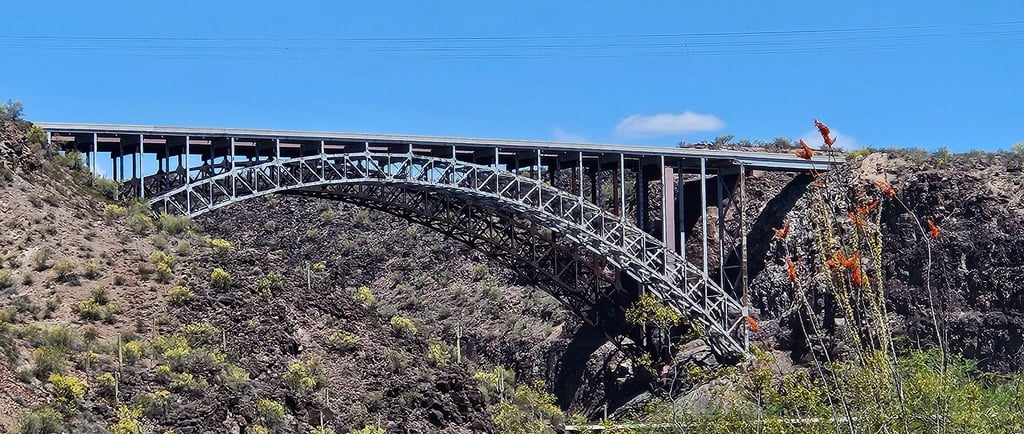
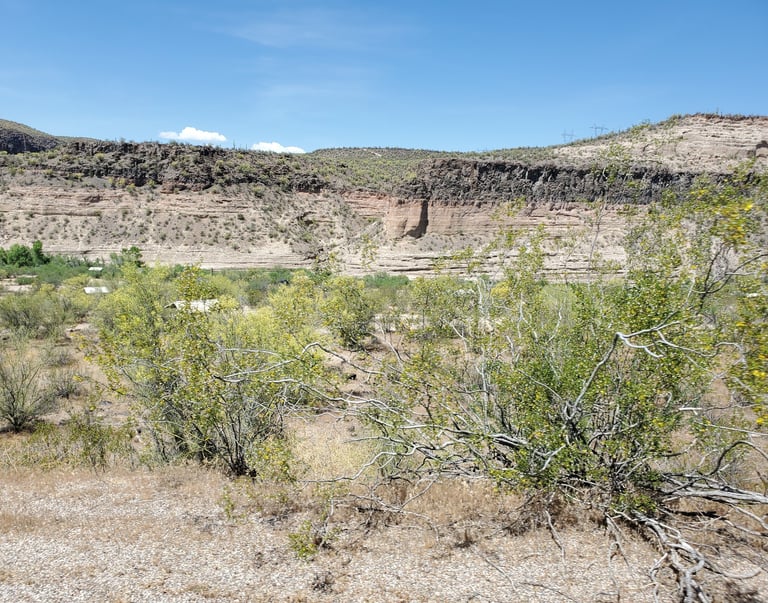
We decided to head south toward Wickenburg on Highway 93. It’s not the kind of Arizona people tend to brag about first. It does not have the instant visual drama of red-rock country or the easy nostalgia of preserved Route 66. It is not theatrical desert. It is not trying to impress you. It is simply there—dry hills, long road lines, sparse settlements, abrupt little outposts, and those wide, unhelpful distances that make the state feel larger than maps admit. It is the sort of country that begins to work on you only after you’ve been in it a while.
That is usually the better kind.
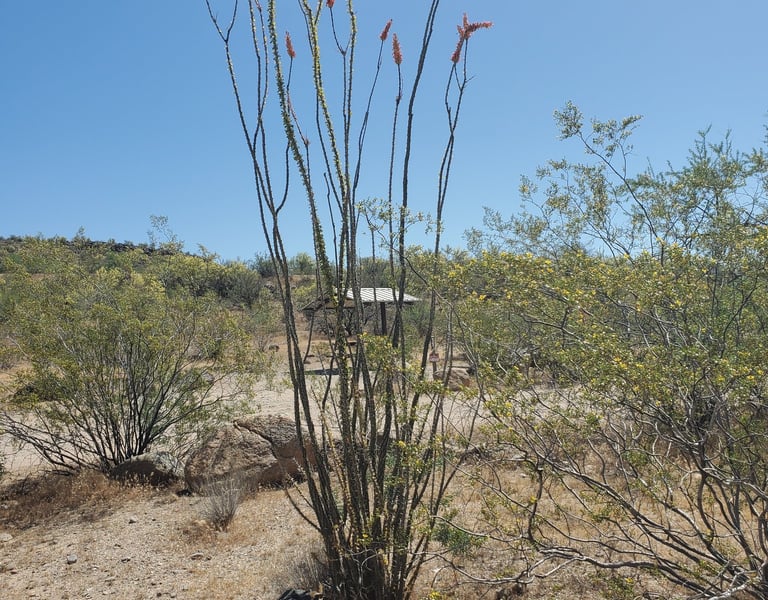
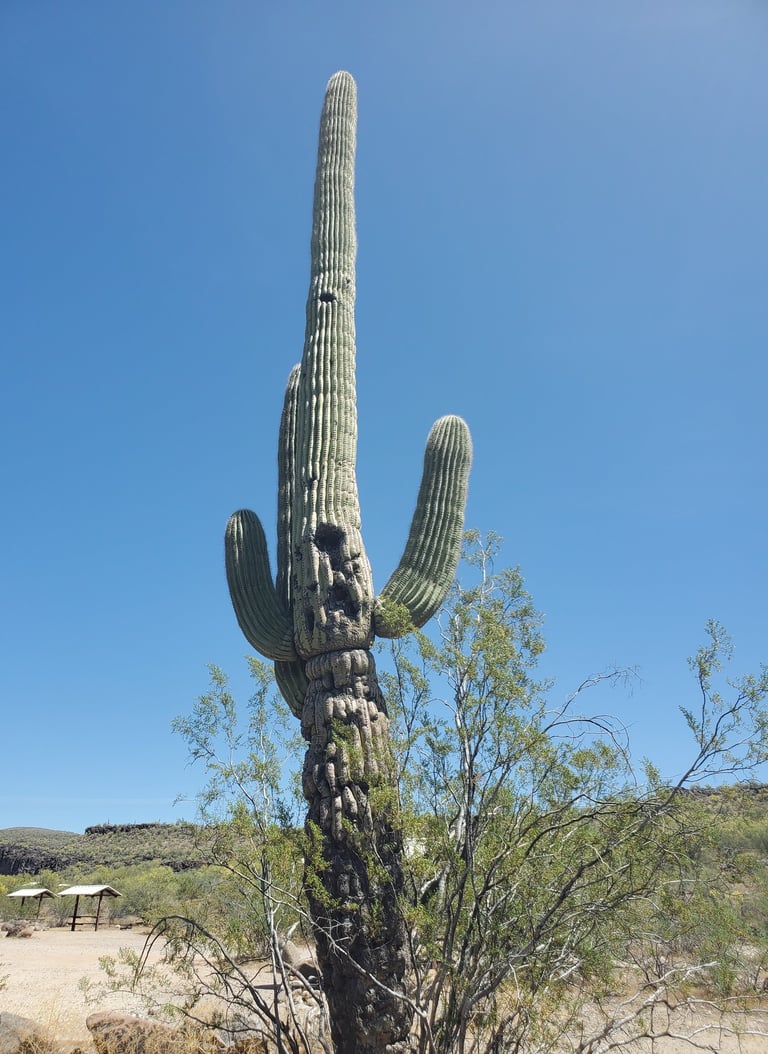
The desert out there doesn’t arrive with one grand reveal. It shifts by degrees. North of Wikieup, the land still carries some of that transitional uncertainty—Mojave influence hanging on in pockets, Joshua trees appearing where they seem slightly out of place, as if the desert itself hasn’t fully chosen its accent yet. Farther south, the Sonoran Desert takes over with more authority. The saguaros begin to appear not as curiosities but as residents. The whole landscape seems to settle into itself.
That subtle change matters more than you’d think.
It is easy to write about dramatic scenery because dramatic scenery does half the work for you. It is harder—and often more honest—to write about land that changes quietly. But that stretch of highway toward Wickenburg had exactly that kind of quiet authority. The road didn’t so much deliver us to a destination as carry us through an argument between deserts. Somewhere near Wikieup, the landscape seemed to hesitate. The saguaros took over the lower country. Joshua trees clung to slightly cooler pockets and uplands. The desert was not switching costumes; it was changing species mid-sentence.
And then there was Wikieup itself.
If Seligman represented the old road as performance, Wikieup represented the old road after the audience went home.
We pulled in because that is what road travelers do. You see a place that looks like it should offer something—a cold drink, a dusty shelf of souvenirs, a small practical kindness—and your body follows an older script. Pull over. Stretch your legs. Walk a little. See what’s there. Maybe there’s a story. Maybe there’s a coffee. Maybe there’s at least a half-broken sign worth photographing.
Instead, there was closure.
The trading posts and roadside shops were all permanently shut. The buildings remained, but in the particular way things do after their purpose has left them. Sun-faded signs clung to the fronts as if they were still trying to describe businesses that no longer existed. The doors were closed with that specific finality that doesn’t feel temporary or seasonal or even disappointing anymore. It simply feels decided. The parking lot looked uncertain about why it was still there.
We walked a little anyway.
Travelers are optimists by habit. We always half-believe that every stop will yield something if we approach it correctly. But Wikieup didn’t offer a snack, a conversation, or a charming ruin polished into meaning. It offered something better and more uncomfortable. It offered an ending.
Not a cinematic ending. Not the dramatic collapse of a ghost town swallowed by sand and legend. Just the smaller, truer kind. A quiet withdrawal. The sort that happens when traffic patterns shift, roadside economies thin out, and places built to serve movement slowly lose their reason to exist. What remains is not spectacle but residue.
That may have been the most honest moment of the trip.
There are stretches of the American West where the romance of the road survives mostly as a delay in demolition. Wikieup had that feeling. Not tragic, exactly. More matter-of-fact than that. The road had changed. The buildings had not. Or maybe they had simply run out of reason to keep pretending. Either way, the silence there felt larger than the stop itself.
And because of that, the rest of the day sharpened.
After a place like Wikieup, you stop expecting every mile to entertain you. The trip deepens. The road becomes less of a curated sequence of attractions and more of what it probably always was: a corridor of need, chance, migration, and weather. People passed through these towns because they had to. They stopped because fuel, water, shade, or gravity required it. That older logic still clings to the landscape, if you let it.
By the time we neared Wickenburg, the day had changed tone again.
Wickenburg is one of those towns that looks better the later it gets. Some places are built for noon and tourism. Wickenburg belongs to the leaning light. It is western in the real sense, not merely the decorative one. Beneath the facades and horse-town signage, you can still feel the harder structure under it: gold, ranching, rail, distance, trouble. The town exists because it once had real reason to exist. That difference matters.
Historically, Wickenburg came out of the desert the way many towns in the Southwest did: through a collision of extraction and survival. Gold at the nearby Vulture Mine. Ranching. River access along the Hassayampa. A supply point becoming a settlement, then a town, then one of those places that almost disappeared and somehow didn’t. It even carries one of those excellent pieces of desert folklore—the legend that if you drink from the Hassayampa River, you can never tell the truth again. That is exactly the kind of local myth a place like Wickenburg deserves. Not a grand haunting. Just a crooked little curse tied to water and memory.
The town has earned its weathering.
That was what appealed to me most by the time we arrived. Wickenburg didn’t feel preserved so much as endured. It did not offer itself like a souvenir. It stood there in the evening light as if to say: this is what survived.
And maybe that is what the trip had become by then—not a cleanly plotted loop through “must-see” places, but a gradual education in what still survives along Arizona’s old and secondary roads. Not just towns, but moods. Not just landmarks, but textures. A whole geography of almost-forgotten usefulness.
That was the larger pattern, once I could see it.
Laughlin had been the first threshold—the river-town version of a beginning, where the desert first acquires a destination feeling. Kingman was the hinge, the transfer point where the trip began slipping from Nevada-adjacent practicality into Arizona road mythology. Seligman gave us the postcard. Wikieup gave us the afterimage. Wickenburg gave us the bones. And somewhere eastward in the alternate route we didn’t fully take—Williams, Winslow, Two Guns, Show Low—there remained the ghost of the other trip we could have had. The gentler one. The more purely Route 66 one. The one that would have followed the old road farther through fragments and alignments, through places like Winslow, where the rail lines and old hotels still hold a little cinematic dignity, and onward into the pine-country relief of Show Low.
But that wasn’t the trip we were having.
And I think that is what made this one better.
The temptation, especially when you care about places, is to imagine that the “best” trip is the one that includes the most atmospherically correct stops. The right town. The right diner. The right overlook. The right surviving stretch of old pavement. But the older I get, the less I trust that logic. A trip isn’t good because it hits the approved highlights. It’s good because the choices begin to feel inevitable once you’ve made them.
This trip had that quality.
Skipping Williams and Ash Fork on paper felt like abandoning the cleaner narrative. In practice, it gave the day its actual shape. Stopping in Wikieup and finding closure instead of charm felt, at first, like being denied a road-trip moment. In truth, it was one of the most revealing moments we got. Choosing Wickenburg over a neater continuation eastward looked like a detour. It turned out to be an arrival.
That is the real privilege of the road—not the scenery, not even the history, but the permission to keep revising what the trip is while you are still inside it.
Somewhere along that Arizona stretch, we stopped trying to drive the ideal version of the Southwest and started moving through the one that was actually there. The practical one. The weathered one. The one with shut storefronts, desert transitions, old mining ghosts, and towns that feel more truthful at dusk than they ever do at noon.
That is the version I trust.
By evening, the trip no longer felt like a Route 66 reenactment or a scenic loop or a checklist of worthy stops. It felt like what the best travel always becomes if you stay out long enough: less about what you came to see, and more about the exact emotional weather of the country you happened to be moving through that day.
That Tuesday, the emotional weather of the country was dry, old, and honest.
And somewhere between the postcard and the silence, that became enough.
Kakkoii Adventures
A couple navigating life's changes, making intentional choices, and living the life made possible.
STAY ConnectED
© 2026 - All rights reserved.
Making room. Choosing what's next. Living the life those choices make possible.
Join us for our twice-monthly newsletter as we share the choices, changes, and adventures along the way.