
Monsters in Yokohama
Marusan Doll Exhibit
CULTURAL
1/27/20263 min read
Yokohama is one of those cities that doesn’t ask you to follow a plan. It keeps changing the subject. One minute you’re walking past the harbor; the next, you’re standing in front of something you didn’t know you needed to see.
There are plenty of things to do here. Restaurants. Ferry rides. Historical sites. This is where Admiral Perry landed in 1853, setting in motion the events that led to the Convention of Kanagawa — also known as the Treaty of Peace and Amity between the United States and Japan — being signed on March 31, 1854. The agreement was concluded at Kanagawa, an area that is now part of modern Yokohama.
There’s also Yokohama Chinatown — the largest Chinatown outside of Zhōngguó. That’s what the Chinese — the people in China — call their country. Not China. They don’t say China. They say Zhōngguó. A strong name. A powerful one. It means the Middle Kingdom. The center.
A lot of people don’t know that. The more you know. It’s beautiful.
Yokohama has no shortage of museums — the Yokohama Museum of Art, the Kanagawa Museum of Modern Literature, the Yokohama Port Museum — all fine places we still haven’t gotten around to. Time has a way of narrowing your choices.
Museums in Japan are usually closed on Mondays, and this was our second-to-last day in the city. With Sunday as our only option, Mary and I had to choose carefully.
So we went to the Yokohama Doll Museum.
We went for a few reasons. Originally we were going to go to see the porcelain doll collection. Thousands of donated pieces. Beautiful collection. But for me porcelain dolls are a little like monkeys. I have some childhood trauma involving both. I’d also been reading about the idea of the “uncanny valley” — the discomfort we feel when something looks almost human, but not quite enough for our brains to accept it as real. Like many of the dolls.
The term was coined in 1970 by Japanese roboticist Masahiro Mori and later expanded on by researchers like Karl F. MacDorman, who explored why near-human faces and figures can feel eerie — mismatched features, frozen expressions, realism that doesn’t quite line up. Interesting stuff.
I’ll write about the porcelain doll collection another time.
But there was another reason we went.
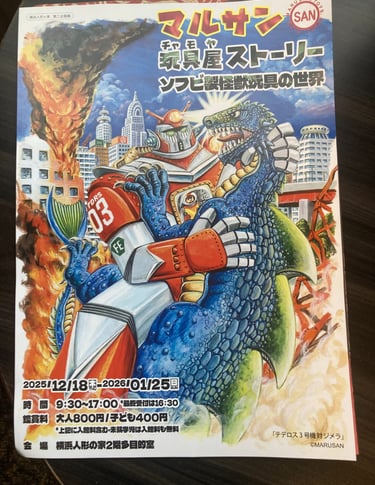
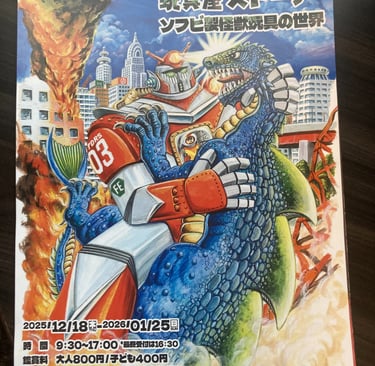
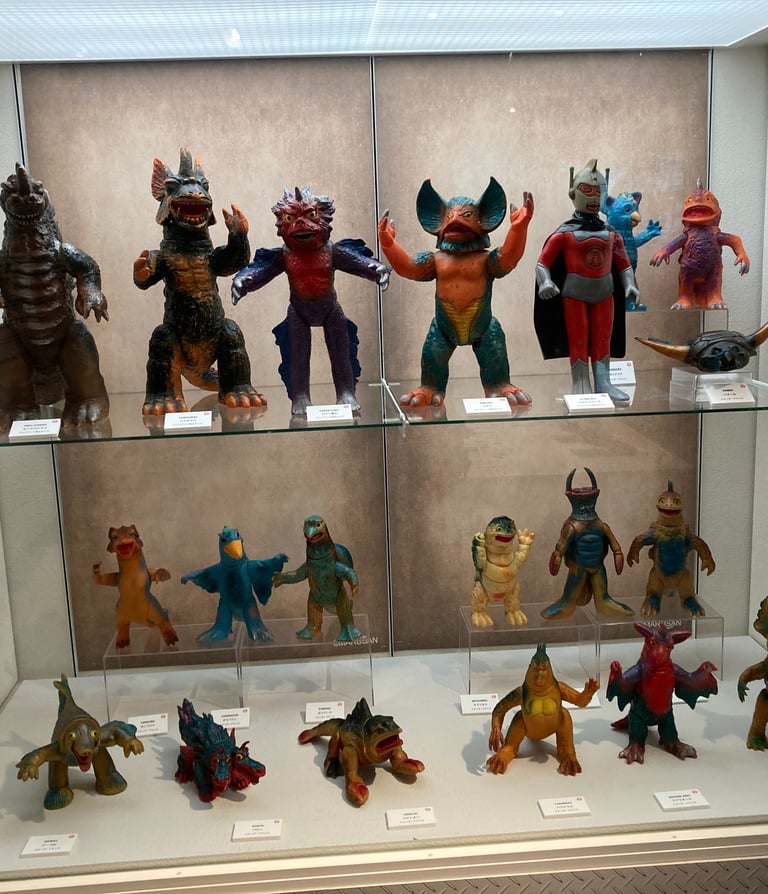
The museum was also hosting an exhibit on Marusan — a Japanese toy company best known for its soft vinyl monster figures from the 1950s through the 1970s.
Their toys resemble many of the monsters from Toei and Toho Studio films of the same period — the Shōwa era. They have their versions of Godzilla, Mothra, and Ultraman: familiar shapes, slightly different names, mostly for legal reasons.
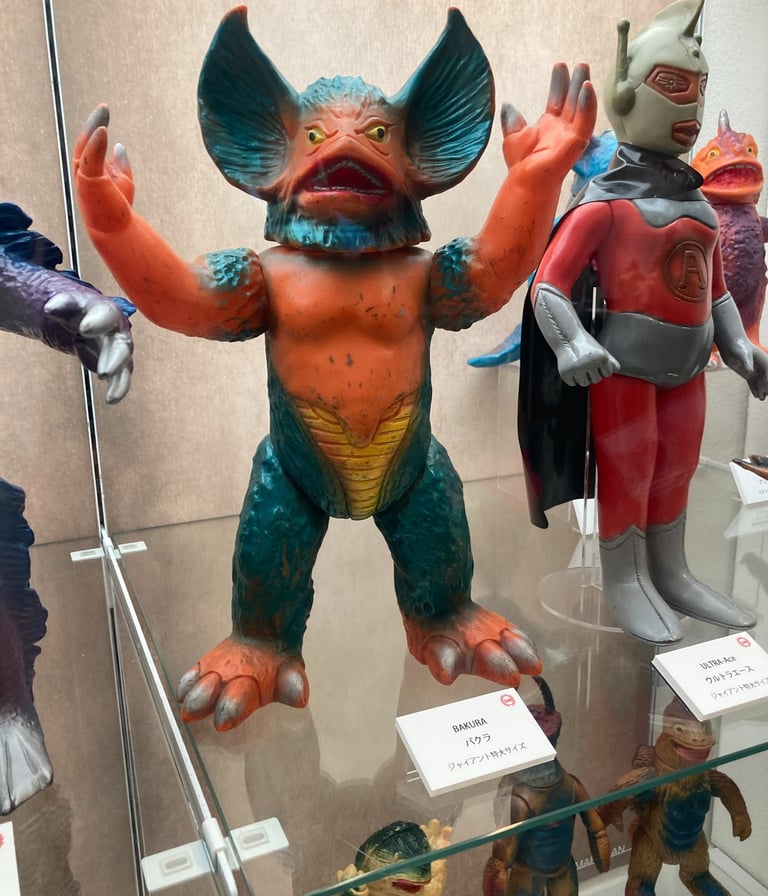
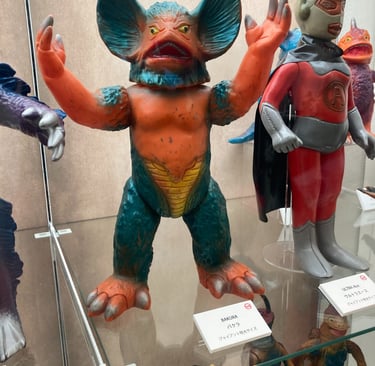
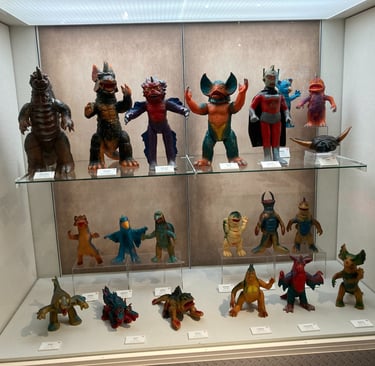
The exhibit itself was a room full of soft vinyl kaiju staring back at us with expressions that suggested they were surprised to be indoors.
This was the Marusan exhibit.
If you grew up thinking monsters were supposed to look terrifying, Marusan quickly corrects you. These creatures have big eyes. Thick arms. Faces frozen mid-roar that somehow come across more as excuse me than I will destroy Tokyo.
They look less like they’re attacking and more like they’ve just realized they left the stove on.
Marusan toys date back to postwar Japan, when monsters weren’t just movie villains — they were companions. These were the kinds of figures kids dragged across tatami mats, knocked over repeatedly, and stood back up again because the monster always deserved another chance.
There’s something deeply reassuring about that.
The monsters are exaggerated and colorful. You can see where realism was abandoned in favor of personality. A little too much forehead here. A grin that goes on too long there. Remember Minilla, the baby Godzilla from Son of Godzilla? More like that.
They don’t try to be accurate. They try to be memorable.
Standing in front of the display, I realized none of them looked angry. They were loud and dramatic, sure — but not angry. These were monsters that expected to be played with, not feared.
They felt like products of a time when imagination did the heavy lifting — when a toy didn’t need backstory, articulation points, or an app. You just picked it up and decided what happened next.
It’s a wonderful exhibit, and I can’t recommend it enough — not just for the nostalgia, but because these figures genuinely feel like pop art. Inside that room, it felt briefly like being invited into someone else’s childhood and being allowed to linger there a while.
If You Go
The Marusan exhibit was held at the Yokohama Doll Museum (横浜人形の家), a short walk from Motomachi–Chūkagai Station near Yamashita Park. Even if you don’t know a single kaiju name, the figures are expressive enough to win you over anyway. Expect to smile more than you planned.
Kakkoii Adventures
A couple navigating life's changes, making intentional choices, and living the life made possible.
STAY ConnectED
© 2026 - All rights reserved.
Making room. Choosing what's next. Living the life those choices make possible.
Join us for our twice-monthly newsletter as we share the choices, changes, and adventures along the way.