
Setsubun
The End of Winter
CULTURAL
2/4/20263 min read
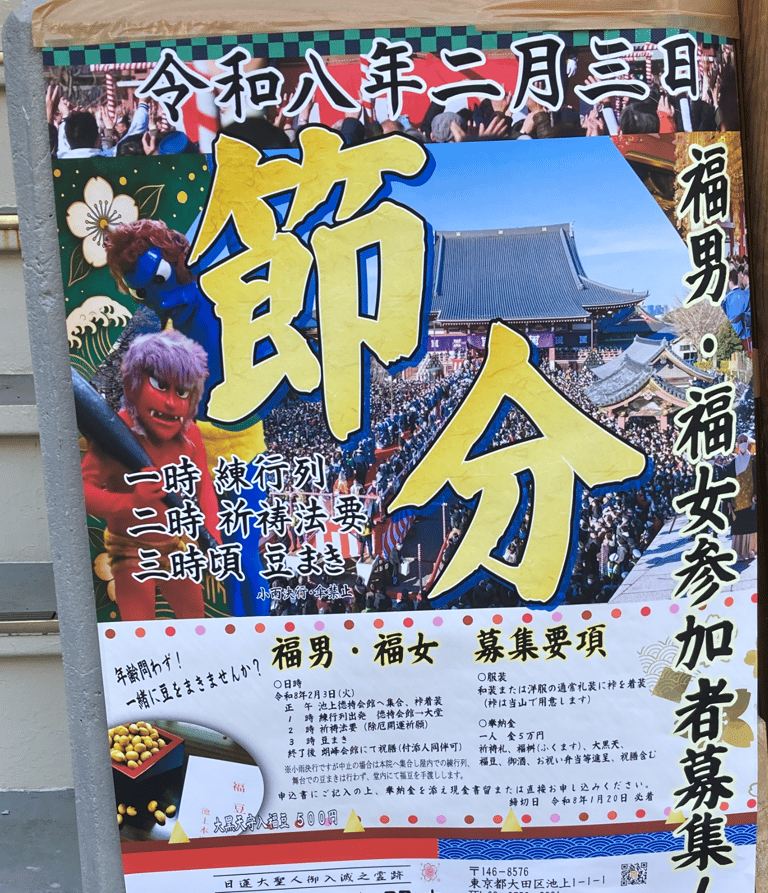
The season of New Year celebrations in Japan gradually draws to a close. It begins with New Year’s Eve and Day (Ōmisoka and Ganjitsu), followed by the First Shrine or Temple Visit of the year, Hatsumōde, traditionally observed during the first days of January. These are followed by Koshōgatsu / Dondoyaki (小正月, January 15, or January 14–16 in some regions), a mid-January observance in which people burn shimenawa, kadomatsu, and other New Year decorations to release the old year and invite good fortune. There is also Hatsuyume, the First Dream night, when dreams are believed to foreshadow the year ahead.
The season concludes with Setsubun (節分) on February 2–3, marking the transition from winter to spring in the old calendar. The tradition blends Buddhism, Shinto, and folk belief, with its rituals centered on purification and protection from misfortune.
On the eve of Setsubun, February 2nd, families perform mamemaki (bean-throwing), shouting “Oni wa soto! Fuku wa uchi!” (“Demons out! Good luck in!”) to drive away bad spirits while welcoming good fortune into the home. One person—often the head of household, or whoever draws the short straw—plays the oni and wears a demon mask.
In our case, because of schedules, we did it on the night of the 3rd rather than the 2nd, and we took turns being pelted with the beans. We each chose a different mask:
Red Oni (赤鬼 — Aka-oni) for anger and aggression;
Blue Oni (青鬼 — Ao-oni) for melancholy and isolation;
Green Oni (緑鬼 — Midori-oni) for greed and desire; and
Black Oni (黒鬼 — Kuro-oni) for fear and the unknown.
We bought the masks at Daiso, the “dollar store of Japan.” Each mask stood for something we needed to shed. I won’t say who chose which color — not out of secrecy, but because none of us are quite as tidy, virtuous, or self-aware as we’d like to be.
We took turns standing by the apartment door. It felt right: if we were casting our flaws out, they should leave through an actual threshold. Everyone else threw roasted soybeans (fukumame) while shouting:
「鬼は外!福は内!」
Oni wa soto! Fuku wa uchi!
“Demons out! Good luck in!”
The aim is simple but powerful — expel misfortune, invite blessing.
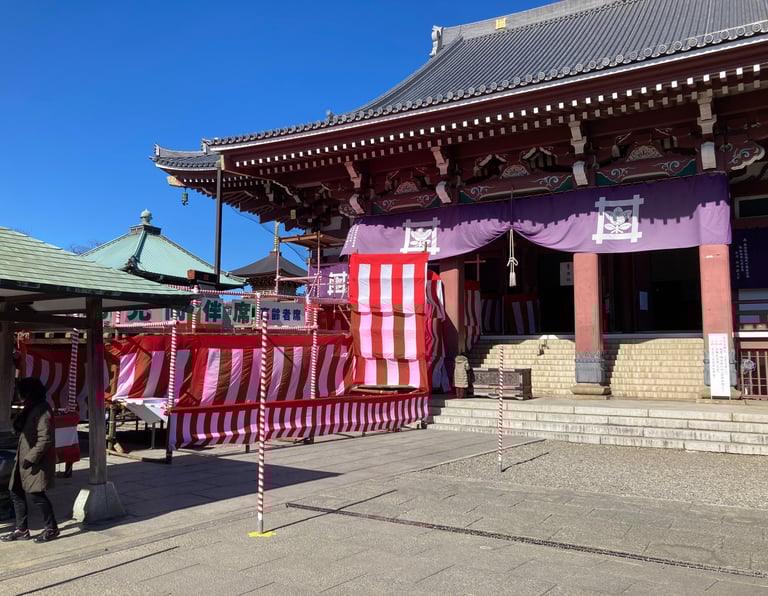
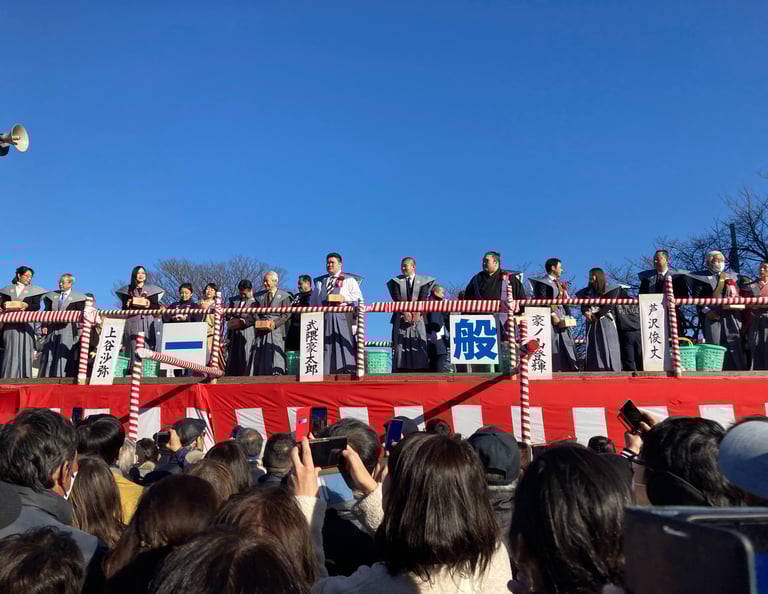
In the morning we had attended the community Setsubun at Honmon-ji Temple. Mary and I spend much of our time in Ōta City, just outside Tokyo, where Honmon-ji rises on a hill overlooking the neighborhood. It’s the largest temple in our area and while we aren’t Buddhist, we try to show up and take part when there is a local ritual, .
Large temples like Honmon-ji play a different role from small neighborhood temples. Here, ritual blends with spectacle: priests, local figures, and invited guests toss roasted soybeans into the crowd, and many people eat a number of beans matching their age for health and luck.
We arrived around 11:30 a.m. to a nearly empty courtyard. I had misread the website, and we were three hours early. We wandered down the hill for lunch at CoCo’s Curry House — their curry, as always, was excellent.
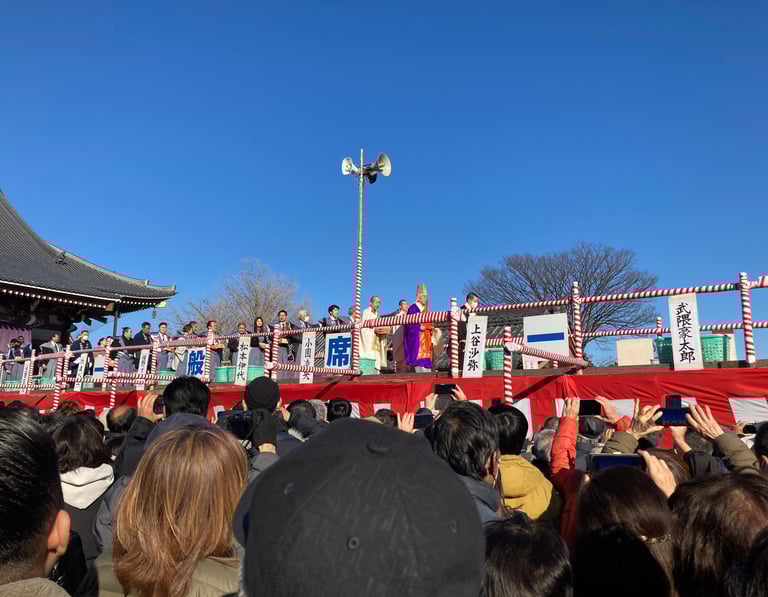
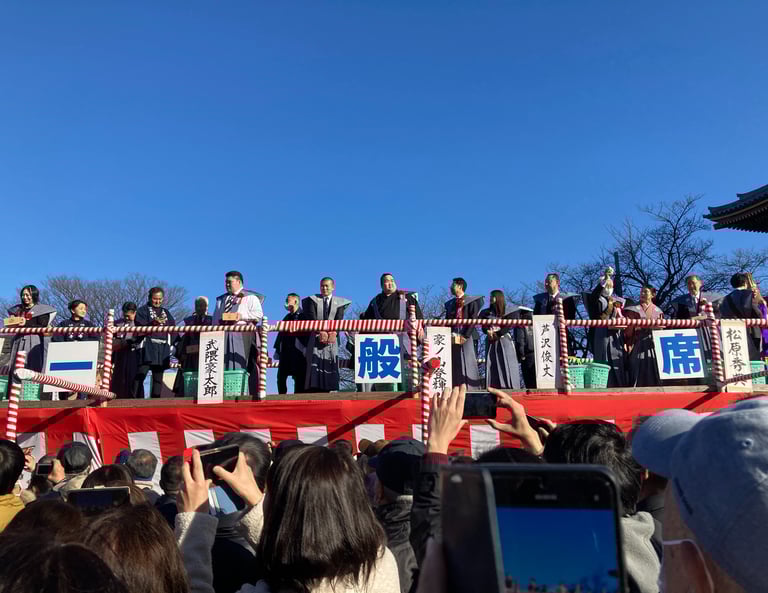
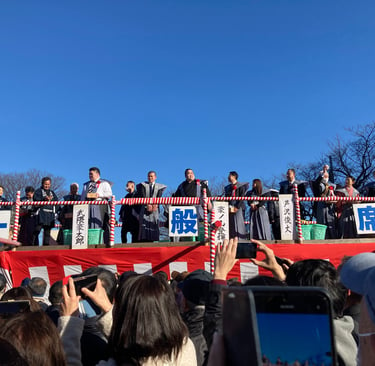
When we returned around 2:30, the grounds had transformed. Families filled the courtyard and gathered around a large raised platform in the center called the mamemaki-dai (literally, “bean-throwing stage”).
On the stage stood the jūshoku, the temple’s head priest, along with local sports figures, mascots, news and weather anchors — even a sailor. It felt very much like a neighborhood celebration rather than a tourist event.
Then the beans came.
These weren’t individual beans like at home, but palm-sized sacks of roasted soybeans. They weren’t thrown hard; they were lofted outward, brushing sleeves, landing in cupped hands, skidding across stone — and occasionally thumping off my head.
I’d like to say everyone behaved calmly. Mostly, they did. But there was one determined older woman behind me who was fully committed to her mission. Being shorter, she leaned in with admirable intensity. And while I’d like to say there was no pushing, there was certainly some enthusiastic jostling.
Still — it was joyful chaos rather than hostility. For a moment, ritual dissolved into play, and the crowd laughed as much as it scrambled.
And that, somehow, felt perfectly appropriate for Setsubun.
When the ceremony ended, we didn’t rush to leave. No one did. People lingered. Children counted beans. Neighbors spoke briefly — warmly — without arranging anything further.
This, I realized, was the true ritual.
Japan has many festivals that burst outward with sound and color. Setsubun, especially at a temple, does the opposite. It gathers people — and then releases them gently back into their lives.
The next day (February 4) is Risshun, the official beginning of spring. Plum blossoms will appear soon. Store displays will change. Pink packaging creeps in. Conversations soften.
Setsubun closes the winter.
Spring begins the morning after — and life renews itself again.
Kakkoii Adventures
A couple navigating life's changes, making intentional choices, and living the life made possible.
STAY ConnectED
© 2026 - All rights reserved.
Making room. Choosing what's next. Living the life those choices make possible.
Join us for our twice-monthly newsletter as we share the choices, changes, and adventures along the way.