
Toei Studios Kyoto
And the Super Sentai
1/14/20265 min read
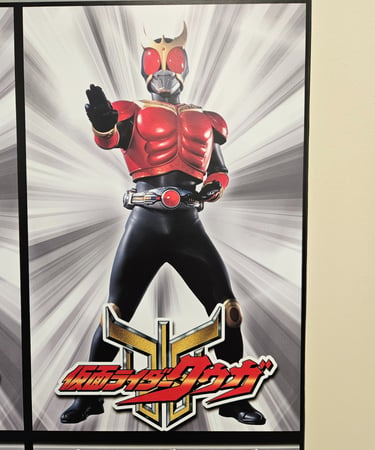
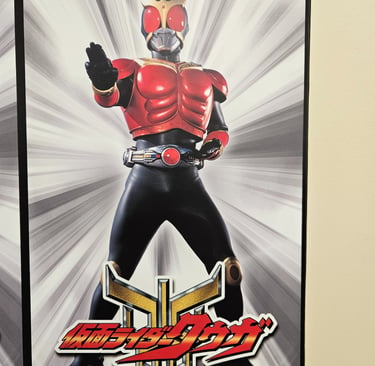
Liam and I merged our individual interests one year, and nearly three years later it landed us on the outskirts of Kyoto.
It was my love of film and his growing interest in Japanese culture that, over the course of a year, led us to watch nearly every movie in the Toho Studios catalogue — including every version of Godzilla battling a variety of opponents and every one of Kurosawa’s films. When Liam was accepted to a Japanese university, our time for watching fine cinema together was running out, and we needed to find another venue. We could have stuck with YouTube videos, but those were more informative than entertaining, so we moved on to the other great Japanese film studio: Toei.
In early summer 2023, Liam and I decided to watch the Japanese version of The Amazing Spider-Man. Legend has it that Stan Lee heard Toei’s take on Spider-Man and gave it his personal blessing, saying it was distinct enough that it wouldn’t be confused with the original cartoon. Toei partnered with Marvel in 1978 and launched their version in a style that would later feel familiar to fans of Power Rangers. Neither Liam nor I had ever been fans of the original Spider-Man, but we both quickly fell in love with this version. I won’t try to describe it — but I do recommend giving it a watch. Just not right now. There are forty-one episodes.
So, three years later, I was tasked with creating an itinerary for our upcoming Kyoto trip. When the name Toei appeared as a local attraction, it was decided that Toei Kyoto Studio Park would be the kingpin around which the rest of the trip would be built.
The studio is located in Higashi-Hachiōkachō, Uzumasa, in Kyoto’s Ukyo Ward — an older section of the city filled with shrines and small shops. It was cloudy the day we went, with rain forecast for the afternoon.
We reached Toei the way you reach so many half-forgotten places in Japan: slowly. A train, then a bus, then a tram — each one smaller and quieter than the last — carrying us farther from central Kyoto and deeper into Uzumasa’s residential streets. When we arrived, the weather was still cloudy but pleasant.
There was no ceremonial approach, no swelling music, no dramatic reveal. We stepped off a small JR tram at Uzumasa and walked past quiet houses, vending machines hawking Boss-brand coffee and soft drinks, and several shrines and temples.
We entered through the museum soundstage side. It turns out there is an entrance directly from the tram stop, but we were distracted and went the long way around. It felt like we had wandered onto a film set between takes.
The park itself is remarkable, full of backlots and shows one would expect at a studio park. Outside the main museum structure is a Japanese village section that has been used in many of the studio’s television shows and movies. Wooden buildings lean toward one another, and traditional lanterns glow faintly even in daylight. A canal slips past a bridge that looks like it has seen more swordfights than weddings. There are wooden walkways, a pond harboring a serpent, an indoor ninja show, and a haunted house styled around Japanese yōkai.
Walking the streets with my family — watching actors bow, fall, leap, and reset — the whole place became something gentler than nostalgia. It was a reminder that imagination doesn’t disappear when an era ends.
Toei Studio was born in 1951, when Japan was still stitching itself back together after the war — a country of black markets, plywood storefronts, and half-rebuilt streets. While other studios chased refinement, Toei chased stories people wanted: samurai, criminals, ghosts, outlaws, folk heroes. It didn’t try to elevate reality. It dramatized it.
Kyoto became its anchor.
While Tokyo reinvented itself as modern Japan, Kyoto became the archive of its past. Toei built permanent outdoor streets here — merchant districts, canals, village lanes, castle alleys — and filmed on them endlessly. These weren’t sets torn down after one movie, but entire neighborhoods that aged, peeled, and were repainted as the decades passed.
If you’ve ever watched a Japanese samurai film from the 1950s through the 1980s, chances are you’ve already seen these streets. The same wooden storefronts. The same bridge. The same crooked alley catching the afternoon light.
When the film industry began to shrink, Toei did something unusual.
It opened the gates.
In 1975, rather than demolish its Kyoto backlot, it turned it into Toei Kyoto Studio Park — not quite a museum, not quite a theme park, but a working film town that allows visitors to wander inside Japan’s own memory machine.
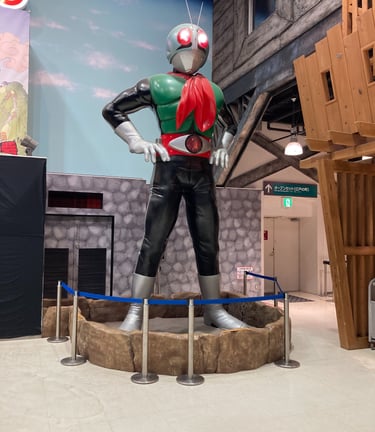
In the early 1970s, these same Edo-era streets became something new. Toei teamed up with manga artist Ishinomori Shōtarō and created Kamen Rider, followed by Himitsu Sentai Gorenger, the first Super Sentai team.
Suddenly, the alley that once hosted a doomed ronin duel became the place where a Red Ranger delivered a flying kick.
The quiet bridge became the backdrop for an explosion. The marketplace became a monster’s lair.
This is where Power Rangers was born.
The stunt performers were trained in samurai choreography. The camera crews had spent decades filming swordplay. That’s why Super Sentai fights move the way they do — halfway between martial arts and kabuki, between comic book and period drama.
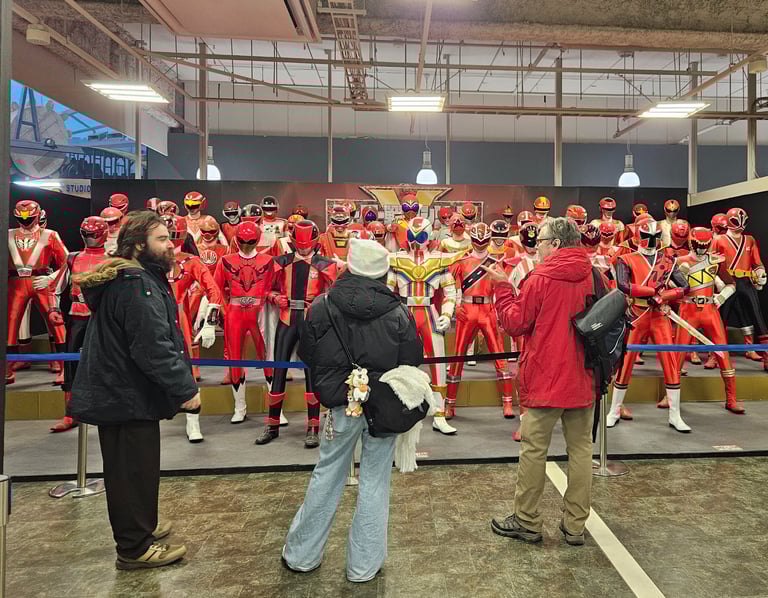
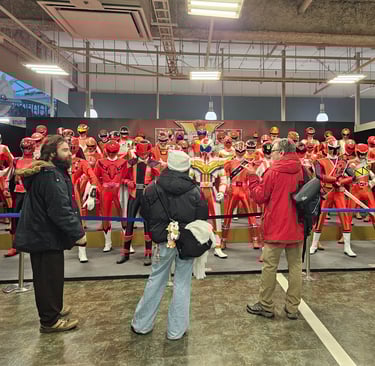
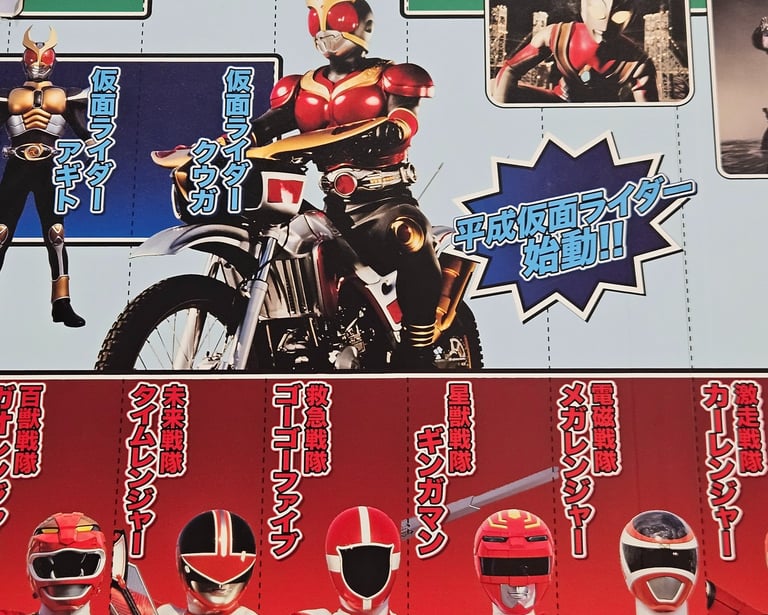
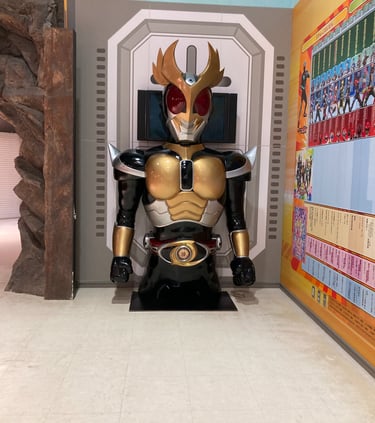
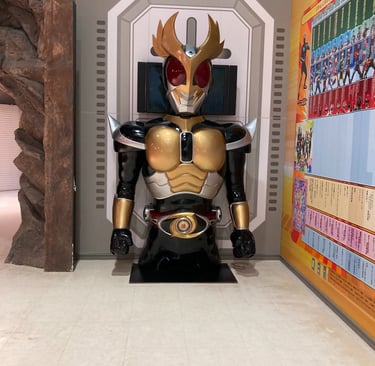
Inside one of the soundstages is a museum. Glass cases line the walls, filled with helmets, weapons, transformation devices, monster masks, and brightly colored suits. It’s an extensive archive of Super Sentai history, laid out not as a celebration of childhood, but as evidence of a cultural machine that never stopped running.
You quickly realize these aren’t disposable props. They are artifacts — scratched visors, faded gloves, rubber monster faces repaired and repainted more times than anyone could count. These were worn by stunt actors who fell off rooftops, rolled down stairs, took explosions, and then stood back up to do it again.
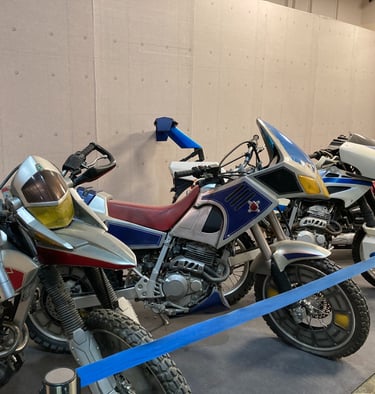
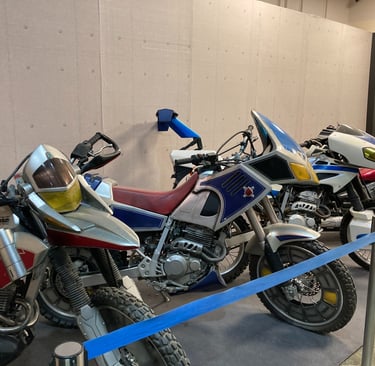
There are motorcycles from the Kamen Rider series, still bearing enough scars to prove they are the real working props from the shows.
The lineage is unmistakable: the armor of Edo warriors has simply become color-coded. In another room, you can trace that evolution of Japanese heroism. The grim, stoic ronin of the postwar years becomes the masked, team-based fighters of the 1970s. The sword becomes a blaster. The clan becomes a squad. But the choreography, the honor, and the dramatic framing all come from the same place.
Standing there, surrounded by helmets that once saved imaginary worlds, you don’t feel nostalgia so much as continuity. These shows didn’t replace samurai stories. They inherited them.
Sadly, though, there was little mention of Spider-Man — no motorcycle, no uniform, no Leopardon, his flying leopard robot. No Sword Vigor. You really should watch the show.
There’s something quietly emotional about realizing that the programs you watched as a kid were filmed on streets that still exist — half-empty, half-remembered. The heroes moved on. The audience aged. But the sets stayed.
This is the last physical footprint of the Super Sentai dream — a place where Japan once taught the world how to imagine heroes in bright colors, fighting darkness with theatrical courage, and where those heroes, somewhere between Edo and outer space, still wait patiently for their next cue.
This is a must-see when you’re near Kyoto.
I’ll end with a travel tip I’ve mentioned before: when going somewhere new, take time to learn a little about the area — even a quick search for local points of interest. If we hadn’t, I think we might have missed the chance to visit our Sentai heroes one more time.
Kakkoii Adventures
A couple navigating life's changes, making intentional choices, and living the life made possible.
STAY ConnectED
© 2026 - All rights reserved.
Making room. Choosing what's next. Living the life those choices make possible.
Join us for our twice-monthly newsletter as we share the choices, changes, and adventures along the way.