
Trailer Life and BLM
Can We live Like This ?
ARIZONA
4/9/20265 min read
Can We Actually Live Like This?
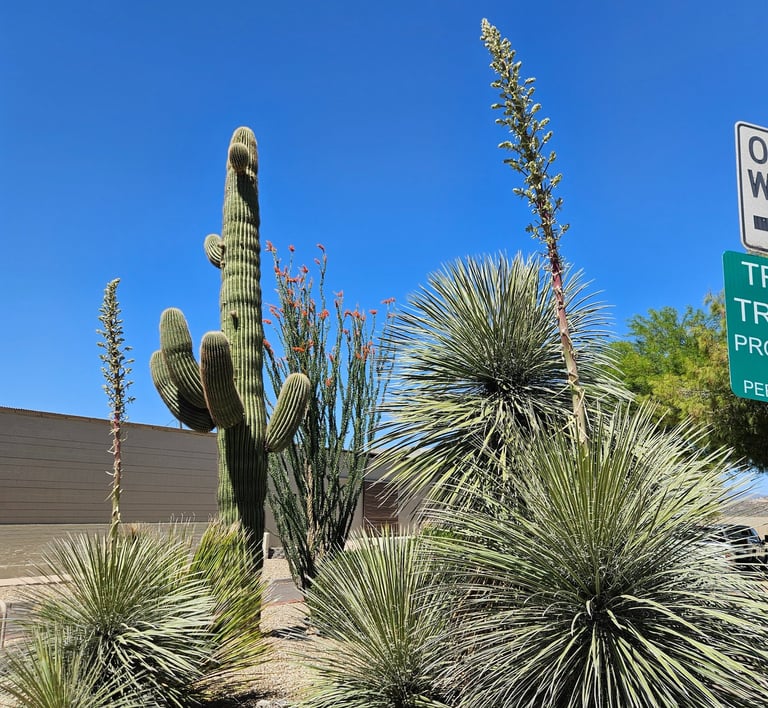
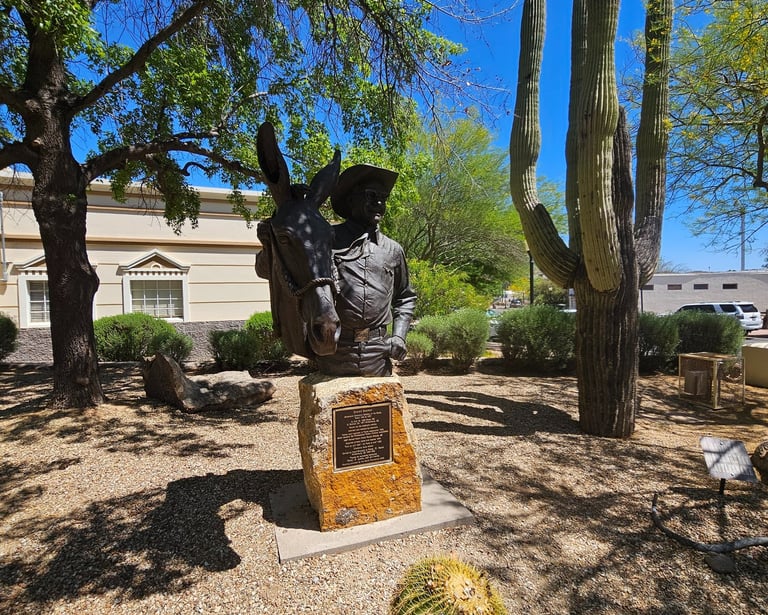
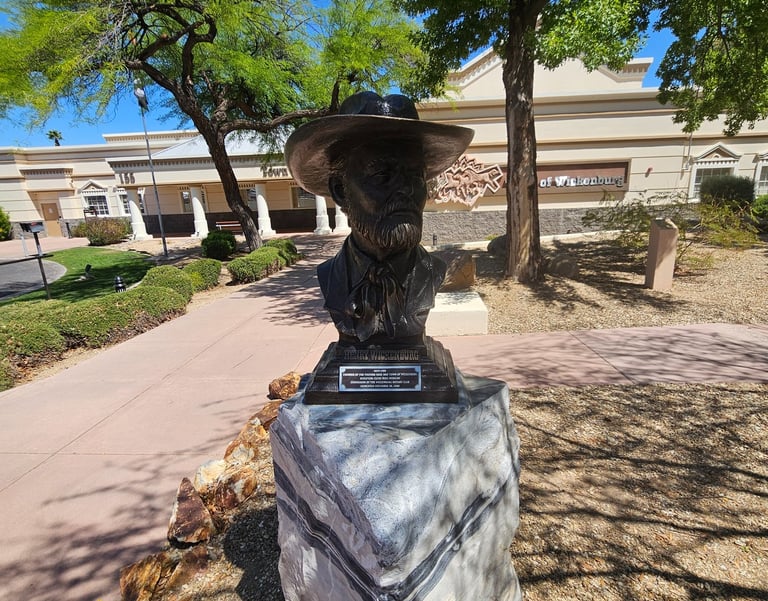
Mary and I have been staying in Wickenburg, Arizona, for a couple of days. We’ve been sightseeing, shopping, and looking at property—the usual for us. It’s a very, very nice town. The weather is perfect, the people are great, and there is plenty of history.
We’ve been staying at a local hotel, which we’ve enjoyed, but it will remain nameless. They’ve been very good to us. There haven’t been any problems, unlike in Laughlin or Seligman.
At the hotel, our neighbor was a lovely lady and her dog. I forgot to ask permission to use her name in my blog, so I’ll call her “K” and her dog “R.” If she reads this, she’ll know I’m talking about her, though I also forgot to mention that I blog.
She was a lovely lady and a senior traveler, much like Mary and me. She has been splitting her time between home and the road for 15 years, usually staying in hotels. She shared stories of her travels across the American Southwest. She has had an amazing life. So has her doggo, “R,” who takes up most of the back seat of her car and always seems ready for the next adventure.
“K” says she wouldn’t have it any other way.
That’s how Mary and I want to travel.
We want to be like “K” and “R.”
We probably need a doggo like “R.”
We have been spending time in Wickenburg, and something about it has settled into us. The light is different here. The air feels open. The town has that rare combination of rough edges and welcome, of dust and possibility. It has made us ask a question that once might have sounded reckless, but now feels surprisingly practical: what if we bought a trailer and lived more lightly?
The hotels have been nice, but not always consistent. Even with chain hotels, there’s a surprising variety in heating, cooling, smells, and amenities. We’ve started thinking about trailer life or van life—not full-time off-grid survival, and not some social media fantasy about waking every morning to perfect desert sunrises while brewing coffee on a camp stove, with no inconvenience, no dust, and no broken water pumps.
Something more realistic than that.
Something more human.
What we are imagining is a hybrid life.
We could stay on BLM land when the weather is good and the land feels generous. For a couple hundred dollars a year, we can buy a pass that lets us stay on certain BLM lands for up to 14 days at a time. After that, you move your rig to another spot at least 25 miles away. Set up the trailer for two weeks, hike, write, live simply. It’s worth a try.
We could move into a hotel when we need a reset—a shower, air conditioning, or simply a night when nothing has to be leveled, emptied, charged, or refilled. When we are back East, where there is less public land and fewer wide-open options, we could stay in paid campgrounds. And three times a year, we go to Japan for about a month at a time to visit our children, staying in the apartment we help support there.
When you say it out loud, it sounds unconventional. But the more we think about it, the less it sounds like instability and the more it sounds like design.
This would not be a life of deprivation. It would be a life of rhythm.
There would be a wild mode—desert land, quiet mornings, coffee outside, and a little distance from the noise of everything. There would be a recovery mode—hotels, campgrounds, laundry, a long shower, and a bed that does not need to be folded back into a bench. And there would be a family mode—Japan, our children, and a completely different world that reminds us what matters and why we want the freedom to live this way in the first place.
That may be the most important part of all: the trailer would not have to be our entire life. It would simply be our American basecamp.
That changes everything.
So many people get into this kind of life by trying to solve all of existence with one purchase. They buy a trailer and unconsciously ask it to be their home, sanctuary, office, emergency shelter, retreat, and proof that they are free. That is too much to ask of a small box on wheels. But if a trailer is simply part of a larger system—one piece of a flexible life—it becomes much more realistic.
And that is really what this idea is about: not escape, but flexibility.
There is also something quietly liberating about the idea of not carrying more house than we need. If we are in Japan for roughly three months a year, and roaming or traveling for much of the rest, then what exactly are we buying if we purchase a conventional home? A place to store our belongings? A structure to insure and maintain while we are elsewhere? A fixed address to justify the expectation that adulthood must always look one particular way?
A house can be a blessing. But it can also become an expensive storage unit with plumbing.
A trailer, if chosen wisely, offers something different. Not luxury, exactly, but mobility. Not permanence, but adaptability. Not a forever answer, but a workable one.
That said, we are not naïve about the realities.
This life would only work if it were built on good systems. We would need a clean plan for mail, residency, vehicle registration, insurance, taxes, and storage while we are overseas. We would need the right trailer—not too large to move comfortably, not too small to become oppressive, not so fancy that every scratch feels tragic, and not so cheap that every trip begins with a repair.
We would also have to accept that desert life is beautiful partly because it is not always easy. There would be heat, wind, dust, tank dumping, battery charging, and the occasional night when a motel room would feel less like indulgence and more like wisdom.
But perhaps that is the point.
We are not looking for purity.
We are looking for a life that fits.
There is a strange pressure in modern life to choose one identity and live inside it permanently: homeowner, retiree, traveler, parent, expatriate, settled person, adventurous person. But what if the truer answer is that we are several of those things at once? What if the best life is not the most fixed one, but the one with enough room to move between worlds?
Wickenburg has made us think about that. Japan has made us think about that. The years themselves have made us think about that.
At a certain point, the question stops being, Is this normal? and becomes, Does this actually fit who we are now?
And perhaps that is the better question.
We are not trying to disappear into the desert. We are not trying to prove anything. We are simply trying to imagine a life that gives us room: room to roam, room to rest, room to see our children, room to come and go without carrying the weight of a life that no longer feels like ours.
And the more we talk about it, the more it seems possible.
Not effortless. Not romantic every day. Not cheap in the simplistic way people often imagine. But possible in the real sense: structured, thoughtful, sustainable, and alive.
Maybe that is enough.
Maybe that is more than enough.
And to “K” and “R,” thank you for sharing your stories. I think they may have helped us in our own journey. Meeting you made this way of life feel a little more real to us.
Stay safe my friends.
Kakkoii Adventures
A couple navigating life's changes, making intentional choices, and living the life made possible.
STAY ConnectED
© 2026 - All rights reserved.
Making room. Choosing what's next. Living the life those choices make possible.
Join us for our twice-monthly newsletter as we share the choices, changes, and adventures along the way.