Vulture Mine - The Return
Part 2
ARIZONA
4/11/20265 min read
Between the Boards and the Dust: A Day at Vulture Mine
This time, we checked the schedule. Yesterday, we hadn’t.
Yesterday turned out well enough—we wandered, did some local sightseeing—but the one place we had come to see was closed: the Vulture Mine.
Today, Mary and I made sure. Thursday was one of the few days the mine would be open, and since we were leaving the Wickenburg area later that afternoon, it felt like our last chance. We didn’t see ourselves coming back. It’s a nice place, Wickenburg, but there’s a lot left to see, and we needed to be back in Sacramento by Tuesday.
So we went.
We drove out expecting remnants—some wood, some rust, a suggestion of what once stood. What we found instead was something fuller, more deliberate. Not a ruin, not quite a museum, and not entirely a performance either. Something in between.
The first surprise was how much there was.
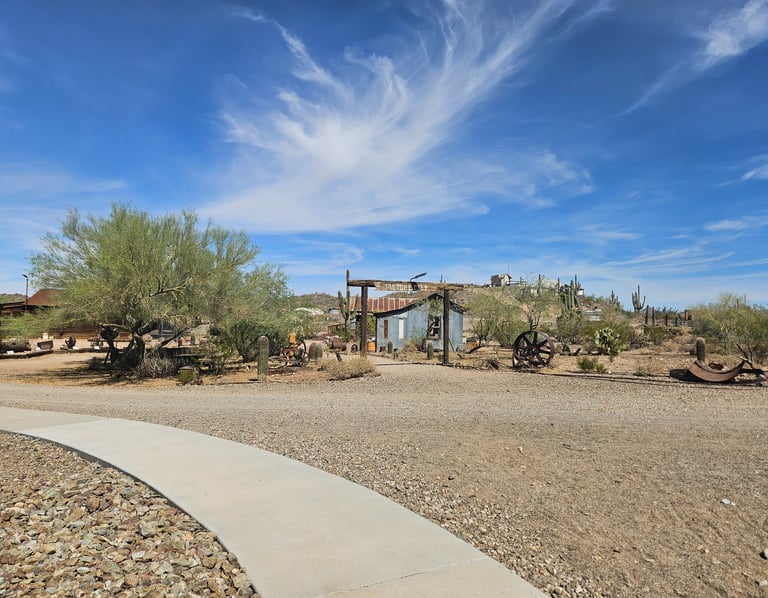
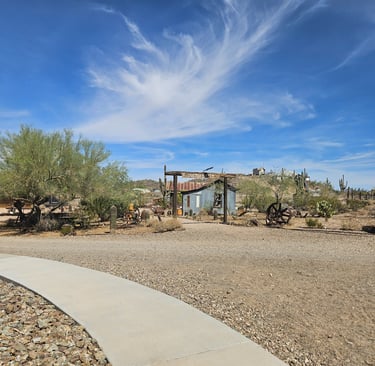
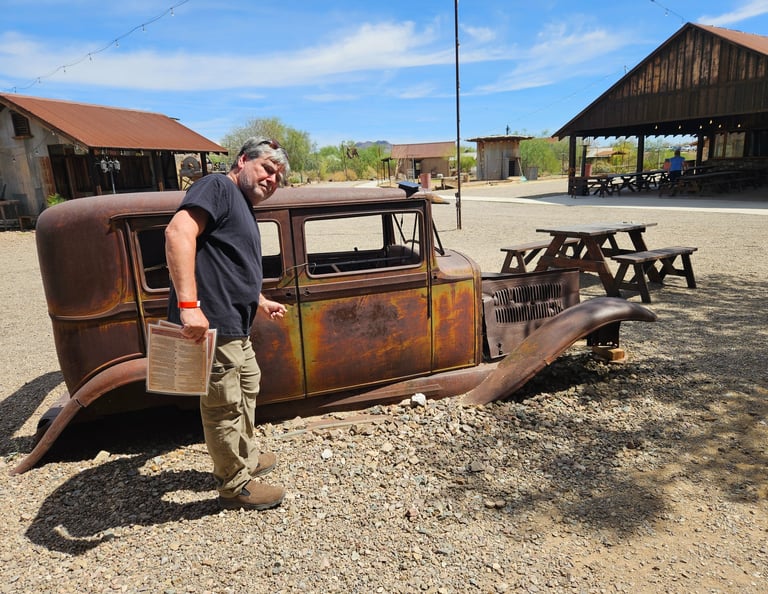
Buildings stood in rows and clusters—the assay office, the cookhouse, and others whose names had faded but whose shapes still carried purpose. Artifacts were everywhere—not tucked behind glass, but arranged and displayed—sometimes staged, sometimes simply present. It felt less like preservation and more like an attempt to reassemble memory.
At first glance, it felt authentic.
Then, as we slowed down, the seams began to show.
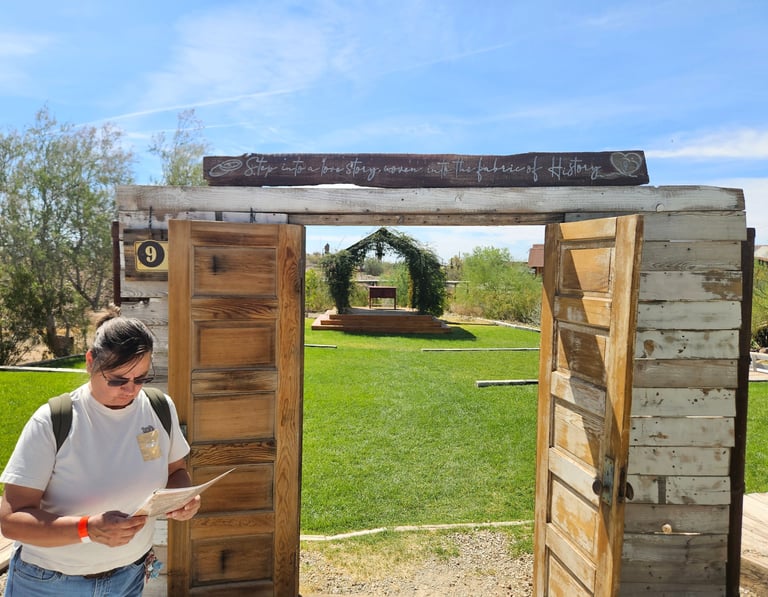
Some of the wood was too straight. Some spaces felt too intentional. A few structures—especially near the event areas—had clearly been rebuilt, raised from older material but shaped for newer use: serving counters, gathering areas, places meant not for miners but for visitors. The past hadn’t been erased—it had been repurposed.
And it wasn’t false. It wasn’t a prop.
It felt like a conversation between time periods—one insisting on survival, the other on accuracy.
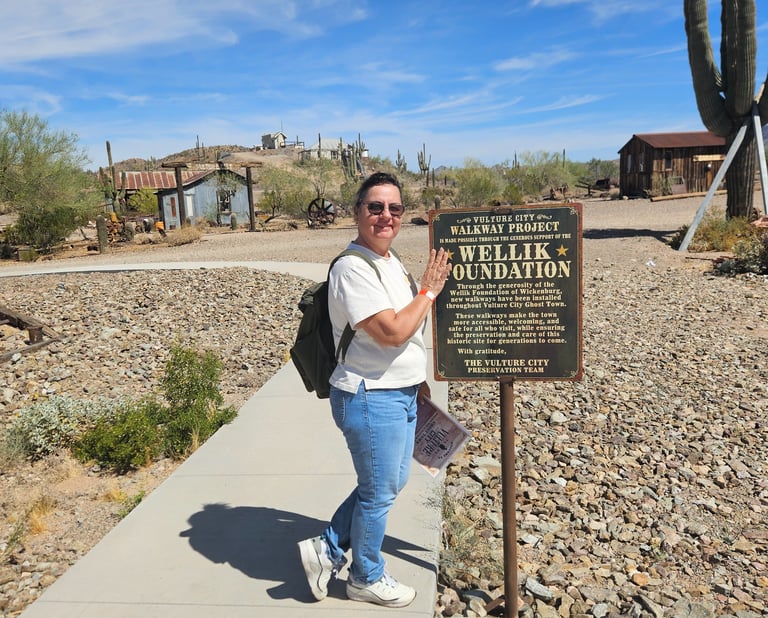
We walked along newly poured cement paths, which surprised us as much as anything. Smooth, clean, clearly recent. They guided us from building to building, past signs that explained what had happened here, who had stood where we stood. The signage was thoughtful—not overwhelming, but enough to keep the story intact.
There was a quiet choreography to it all.
We were meant to move a certain way. To see things in a certain order. To understand.
And for the most part, it worked.
But every now and then, something slipped through.
We met the snake wrangler.
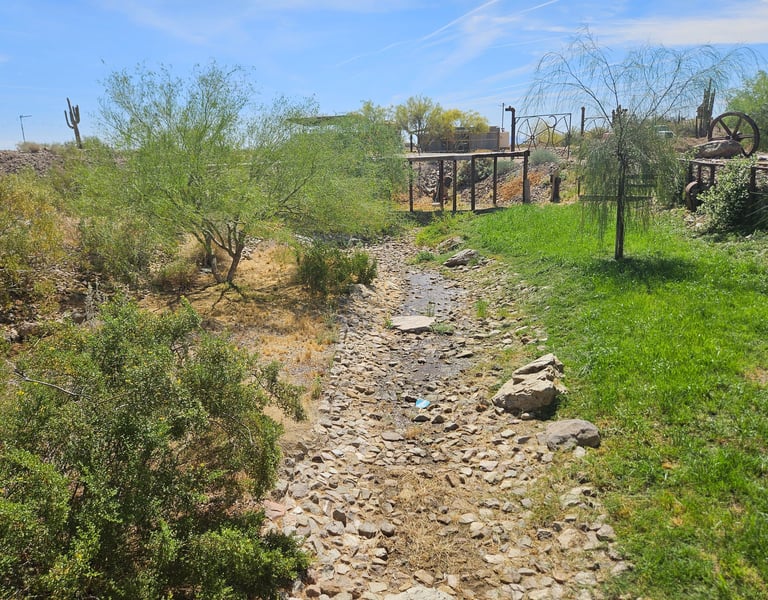
That alone was enough to remind us where we were—not in a reconstruction, not in a sealed historical space, but in the desert. A place that still belonged, at least in part, to what had always lived there.
He wasn’t theatrical. No performance, no exaggerated presence. Just a man doing a job that made perfect sense once you thought about it. Old wood, shaded corners, stone foundations, quiet spaces left undisturbed—of course something would move in.
It was his territory too.
Later, we saw it.
A rattlesnake—greenish, thicker than I expected—lying in the middle of the road as if it had chosen that exact point and settled there with intention. It didn’t hurry. It didn’t seem concerned. It simply existed, stretched across a strip of pavement cutting through an older world.
That moment cut through everything else we had seen.
All the careful restoration.
All the curated artifacts.
All the paths and signs.
And then this.
A living thing, uninterested in any of it.
It had no stake in preservation or storytelling. It didn’t care what had been rebuilt or what had been lost. It wasn’t part of the narrative, and yet it felt like the most honest piece of the place.
We gave it space. There was no question of that. It held its ground—or maybe the ground held it—heat rising from the pavement, the day settling into evening. Maybe it had been crossing. Maybe it was resting. Maybe it had eaten recently and simply didn’t feel like moving.
Whatever the reason, it stayed long enough to leave an impression.
And then we moved on.
Back inside the site, the balance became clearer. Vulture Mine isn’t trying to be untouched. It isn’t Bodie, held in suspended decay. It isn’t Calico, polished into a near-perfect vision of the past. And it isn’t Tonopah, where machinery rusts exactly where it died.
It’s something else.
It’s a place that almost disappeared.
You can feel that in how it’s been handled. The decisions are visible if you look closely: what to rebuild, what to leave, what to guide, what to allow. It feels less like preservation and more like negotiation.
If a building weakens, it’s reinforced. If it falls, it’s rebuilt. If a space needs to serve people now, it’s adapted. The goal isn’t purity—it’s continuity.
And that raises a quiet question that followed us as we walked: what does it mean to preserve a place?
Is it leaving it exactly as it was, even if that means losing it piece by piece?
Or keeping its shape intact, even as the materials change?
Vulture Mine seems to answer:
Keep it standing.
Let people walk through it.
Let it live, even if that life is different.
Mary and I didn’t say any of this out loud, but it was there in how we moved. We slowed in certain places, lingered in others. We noticed small things—joints in the wood, patterns in the dirt, the way one structure leaned while another stood firm.
It’s strange how quickly you start reading a place like that.
You begin to see layers.
Original wood darkened by time.
Replacement beams just a shade newer.
Artifacts that feel placed versus those that feel abandoned.
And yet the impression holds. The place still works. It still tells its story.
Maybe that’s the point.
At one of the event areas—the ones clearly adapted for modern use—we paused longer than expected. Easy to dismiss at first glance: too clean, too functional, too obviously not part of the original operation.
But then it shifted.
Without those spaces, would the rest still be here?
Without events, visitors, some level of modern use—would the buildings have been maintained? Would the artifacts have been gathered and protected? Or would it all have slipped back into the desert, board by board, until nothing recognizable remained?
There’s an honesty in that trade.
You give up a little authenticity in material.
But you preserve something larger—the experience, the presence, the ability to stand there and feel it.
And maybe that’s what we’re really after when we visit places like this.
Not perfect accuracy.
But connection.
By the time we left, the light had shifted. The desert does that quietly, almost without warning. Colors flatten, then deepen again. Shadows stretch. The temperature drops just enough to notice.
I kept thinking about the contrast of the day.
We had walked on new cement paths through a carefully guided version of the past. Read signs, followed routes, moved through reconstructed spaces. And then, just outside that structure, something entirely outside it—a snake stretched across the road, as it might have been a hundred years ago, or a thousand.
Nothing about that moment had been arranged.
It didn’t care about opening hours or visitor flow. It didn’t belong to the narrative, and it didn’t need to.
And that’s what stayed with me.
Not the artifacts, impressive as they were.
Not the buildings, restored or original.
Not even the sense of history, though it was strong.
But that interruption.
That reminder that no matter how carefully we preserve, restore, or reinterpret a place, something always exists beyond it—older, quieter, and entirely indifferent.
We build paths.
We place signs.
We tell stories.
And just beyond all that, something waits in the heat, stretched across the road, unchanged.
It doesn’t belong to the past.
It doesn’t belong to us.
It just is.
And for a moment, standing there, so were we.
Kakkoii Adventures
A couple navigating life's changes, making intentional choices, and living the life made possible.
STAY ConnectED
© 2026 - All rights reserved.
Making room. Choosing what's next. Living the life those choices make possible.
Join us for our twice-monthly newsletter as we share the choices, changes, and adventures along the way.