
Where the Jazz Waits
Walking Dobuita Street
1/26/20263 min read
Mary and I have been staying in Yokohama for about a week. We like Yokohama. It is very Japanese in its food, culture, and people. We also like it because it carries a Western influence; Western food is readily available, and hotel rooms seem a little bigger. We would probably live here if we could.
Near Yokohama is Yokosuka. It’s a large, older town with a vibe similar to Sangenjaya. There’s a bohemian atmosphere — musicians, artists, bookstores, vintage clothiers, and jazz. We visited one afternoon nearly three years ago and have tried to get back ever since. This time, we finally scheduled a day off and took the subway to Yokosuka-Chūō.
We stepped off the train at Yokosuka-Chūō Station around noon, in the middle of the day, which immediately felt like a mistake.
Nothing was wrong, exactly. The platforms were clean. The station announcements echoed politely. Shopkeepers, commuters, and students moved through the ordinary choreography of a functioning city. But whatever we had come looking for was not yet awake.
We exited through the ticket gates onto the upper level. The platform is circular, and from there you can see three roads passing roughly beneath it, each spaced about 120 degrees apart. One of them leads into downtown Yokosuka and runs toward the naval base. That road becomes Dobuita Street. We’ll come back to that.
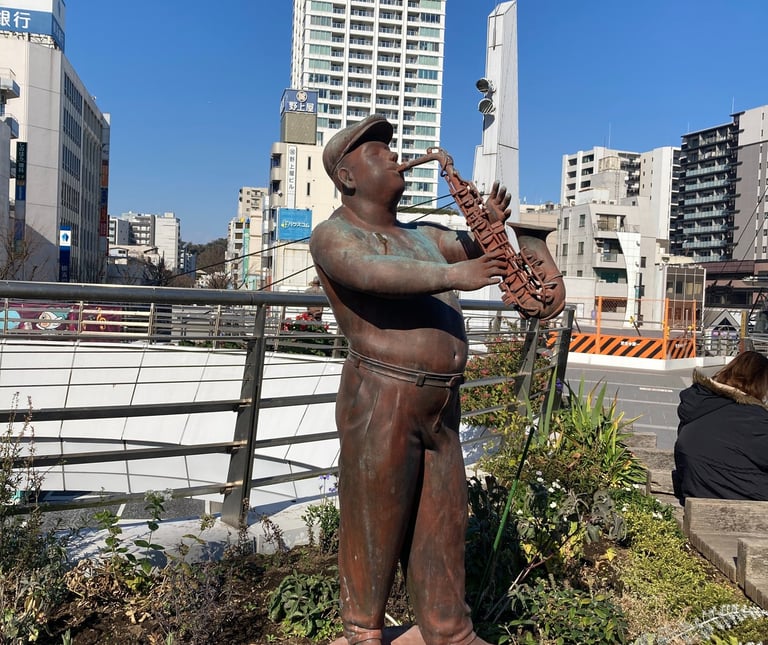
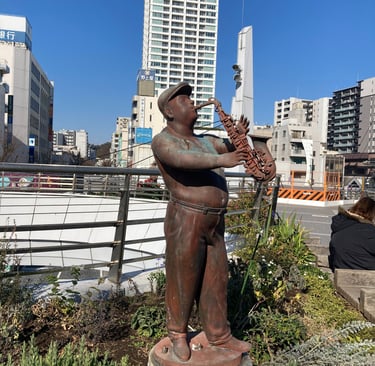
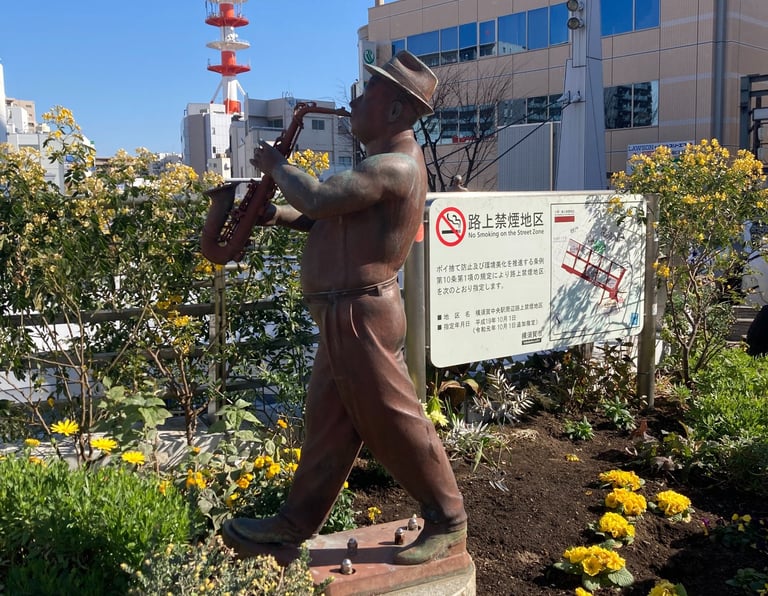
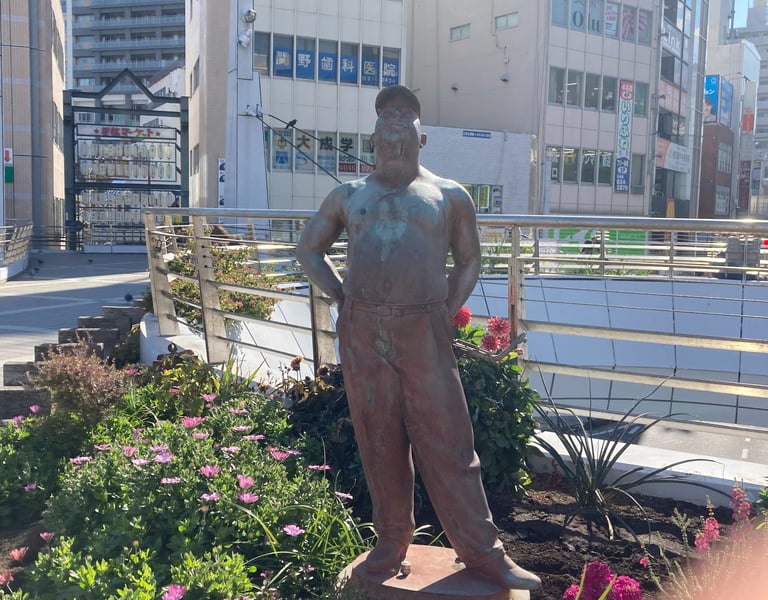
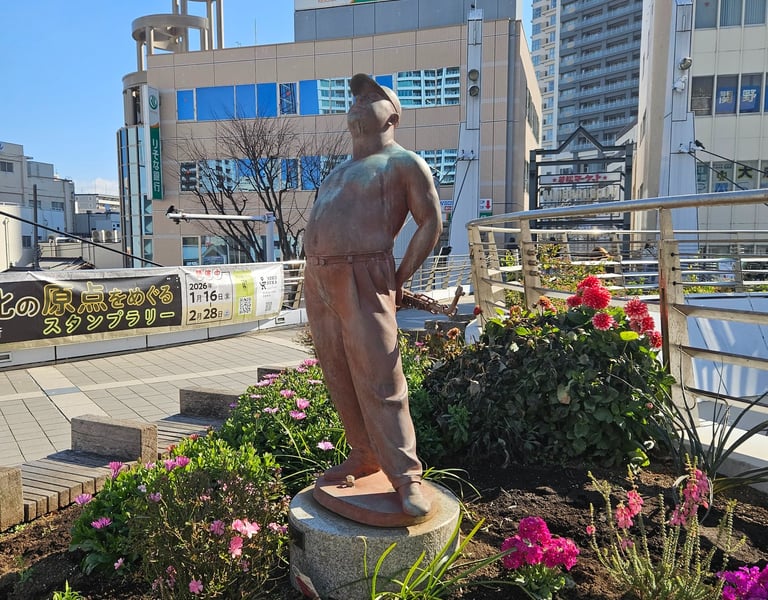
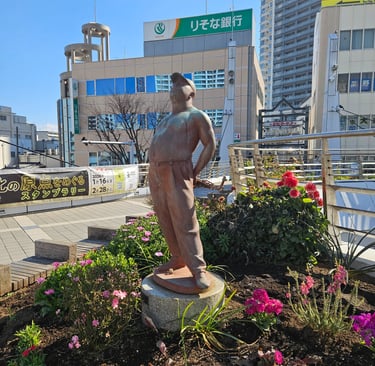
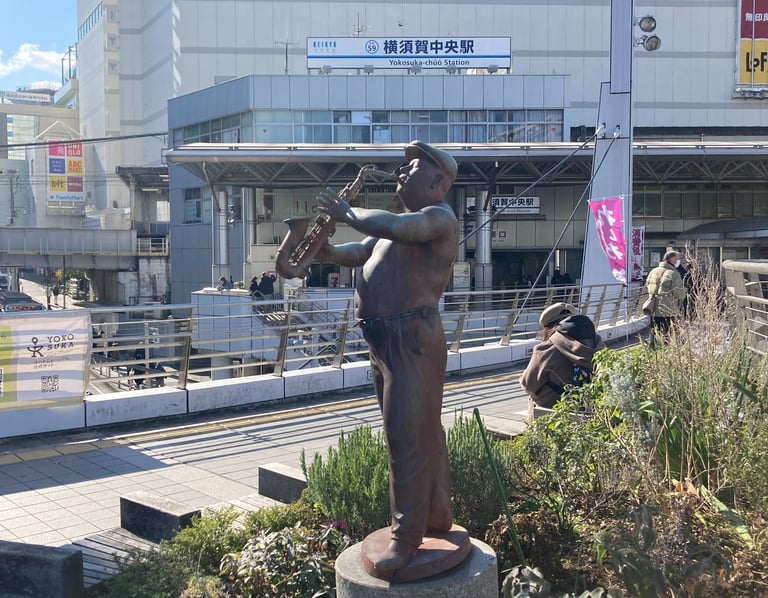
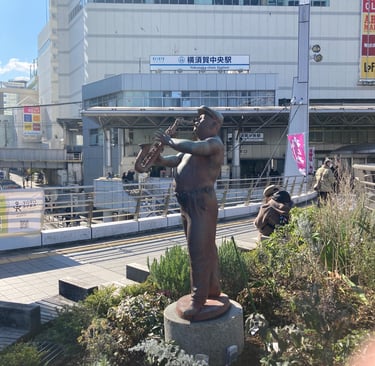
On the platform stand three bronze statues of saxophonists — roughly the same size, all shirtless, all wearing wide smiles. Two are playing their instruments. One holds his casually at his side. They look happy. They look like they’re waiting for the set to begin, frozen mid-performance.
It’s a comforting feeling. I had just stepped off the train and was already beginning to understand the city.
At street level, you find yourself on Dobuita Street, in a historic district — the center of Yokosuka’s jazz culture.
Dobuita Street is narrow and unassuming in daylight. A handful of shops open early. Clothing racks spill onto the sidewalk. A bar owner washes down the pavement. There’s even a statue of an oversized eighth note.
Yokosuka is often described as the birthplace of postwar jazz in Japan, but that phrase can feel bloodless on paper. It doesn’t explain why jazz took root here, or what kind of lives unfolded beneath those notes. To understand that, you have to understand what Yokosuka was — and still is.
It is a port city. A naval city. After World War II, Yokosuka became one of the most significant U.S. naval hubs in the Pacific. Thousands of American servicemen passed through its gates. They brought money, homesickness, and a hunger for the familiar. They wanted hamburgers. They wanted English. And at night, they wanted music that sounded like home.
Jazz filled that need.
Local Japanese musicians began performing in clubs near the base — not as cultural ambassadors, but as working artists. Many learned American standards by ear. Others studied records until the grooves wore thin. Night after night, they played for audiences who might be gone by morning.
The streets outside the base gates transformed. Bars multiplied. Dance halls opened. Neon signs flickered in English and katakana. Dobuita became a corridor of sound — swing pouring from open doors, drums competing with laughter, saxophones riding the night air all the way to the harbor.
For the musicians, this was an education. Jazz, unlike many imported forms, does not tolerate imitation for long. You can copy the notes, but eventually the music demands that you say something of your own — and Japanese musicians began doing exactly that.
They absorbed American jazz and reshaped it. It became less about dancing and more for those who were awake too late.
That quality still lingers in Japanese jazz today — a sense that the song is less a performance than a shared atmosphere.
Walking Dobuita in daylight, it’s difficult to imagine that intensity. The clubs are closed now. Their signs hang quietly. Some sit on second floors, reachable only by narrow staircases that seem to lead nowhere. Many appear unchanged since the 1960s.
As we wandered the street, we realized there was nothing overtly nostalgic here. No memorials to the past. No sense of loss. No plaques shouting dates. No recordings playing for tourists. It’s a living, working town that simply happens to love jazz.
There’s something deeply honest about that.
Jazz fits perfectly here. Even now, decades later, the city continues to mark that inheritance. Jazz festivals return every autumn. Temporary stages rise near the harbor. Unfortunately, we were here in winter. Next year.
And yet, I think the truest version of Dobuita might be the one we saw — quiet, sunlit, holding its breath. Waiting for the night. And for the people.
As the sun set and the lights flickered on, crowds began to form. Office workers emerged. Trains arrived, carrying the city back into motion. The stage was set for another Saturday night in Yokosuka as the characters took their marks.
Jazz still belongs here.
Because jazz understands waiting.
Just like we did — waiting for the next train back to Yokohama.
Kakkoii Adventures
A couple navigating life's changes, making intentional choices, and living the life made possible.
STAY ConnectED
© 2026 - All rights reserved.
Making room. Choosing what's next. Living the life those choices make possible.
Join us for our twice-monthly newsletter as we share the choices, changes, and adventures along the way.