
Night of 100 Yokai: Yokai Parade Invitation
Discover the fascinating world of yokai in Japanese folklore, including how household items transform into these mythical beings. Join us for the Yokai Parade and explore its rich history and cultural significance.
CULTURAL
10/8/20265 min read


One of the things I have learned about traveling with family is that sometimes the most memorable experiences aren't the places you originally planned to remember. You may go somewhere expecting to see a museum, a temple, or an exhibition, and instead discover a whole new piece of the country.
That happened to us in Tokyo when we visited an exhibition devoted to yōkai, the strange supernatural creatures of Japanese folklore.
The exhibition, YOKAI Immersive Experience Exhibition TOKYO – Imagination of Japan, was held at Warehouse TERRADA in Shinagawa. It introduced us to a world of oni, tengu, kappa, foxes, ghosts and countless other strange beings.
At first, it was easy to think of the yōkai as simply Japanese monsters. But as we walked through the exhibition and learned more about them, we began to realize that they were something much more interesting.
A yōkai can be a monster, but it can also be an animal with supernatural powers, a mysterious spirit, or even an unexplained event. Some are frightening. Some are mischievous. Some are helpful. And some are simply strange.
One of the ideas I found especially fascinating was the tsukumogami—objects that acquire supernatural life.
Imagine an old umbrella that has been used for years and then thrown away. In the world of yōkai, that umbrella might not simply disappear into the trash. It might grow eyes, arms and legs and become a creature of its own.
Old cooking utensils, musical instruments and other household objects could be transformed in the same way.
It was a wonderfully strange idea to encounter as a family because it made us look at ordinary things differently. An old object wasn't necessarily just an old object. In Japanese folklore, it could have a history and perhaps even a personality.
We eventually came across the Hyakki Yagyō, the famous Night Parade of One Hundred Demons.
Imagine Kyoto hundreds of years ago, after dark. The streets are quiet. Everyone is safely inside. Then, from somewhere in the darkness, a procession begins. The oni appear. Strange animals emerge. Ghostly creatures and monsters join the procession. And among them are objects that have somehow come alive. They all move through the nighttime streets together.
The “one hundred” doesn't necessarily mean that there were exactly one hundred creatures. Different stories and works of art contain different yōkai. It is more an expression of a huge, almost uncountable supernatural gathering.
The traditional warning was not to be outside when the parade passed and that seemed like pretty good advice.
What made the experience even more interesting was discovering that the Night Parade wasn't a modern invention. Stories of the Hyakki Yagyō go back centuries. One early literary account appears in the Konjaku Monogatari-shū, compiled around the twelfth century. In the story, Fujiwara no Tsuneyuki encounters the supernatural procession while traveling through Kyoto at night and survives because he possesses a protective Buddhist incantation.
Suddenly, something we had encountered in a modern Tokyo exhibition was connected to the ancient history of Kyoto and that gave our trip another dimension.
We weren't simply looking at imaginary monsters.
We were looking at a tradition that had traveled through Japanese history: from Heian-period stories to modern manga, anime and movies.
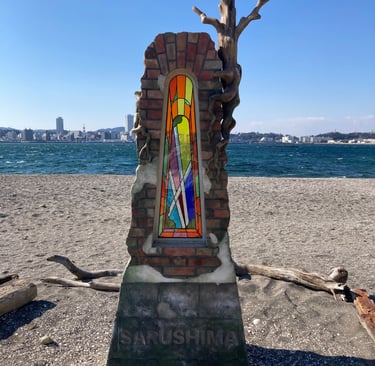
The Tokyo exhibition itself wasn't simply a Kyoto exhibition moved to Tokyo. It had cooperation from the Yokai Art Museum on Shodoshima and the Iwase Bunko Library.
But Kyoto has a particularly strong connection to the Night Parade. Kyoto was the imperial capital during the period when many of these stories developed, and medieval legends placed supernatural processions in the streets of the old capital.
Knowing that changed the way I thought about Kyoto.
When you're traveling as a family, it's easy to concentrate on the obvious sights—the temples, shrines, gardens and famous streets. But knowing some of the old stories gives those places another layer. The city begins to feel like more than a collection of historic buildings. It becomes a place where stories happen.
One of the things we discovered was that yōkai don't fit neatly into the category of "good" or "evil." A kitsune, or fox, might deceive a person, but foxes were also associated with Inari and could be regarded as supernatural messengers. A tengu might be frightening and dangerous, but also became associated with mountains and Buddhist traditions.
The creatures were often ambiguous—sometimes frightening, sometimes amusing and sometimes even helpful. That ambiguity is part of what makes them so different from the traditional Western idea of a monster.
A monster is usually something you want to defeat. A yōkai can simply be something that makes the world strange.
Another thing that made yōkai interesting to us as travelers was their connection to particular places. Different parts of Japan developed their own creatures and legends. A mountain, pond, bridge or village might have its own supernatural story.
A particular pond might be the home of a creature. A mountain might belong to the tengu. A lonely road might have a legend. A strange rock might have a story attached to it. Once you know those stories, you don't look at the landscape quite the same way.
Perhaps that is what made the Tokyo yōkai exhibition memorable for me.
We went in expecting an exhibition. Instead, it became the beginning of a story that reached backward through Japanese history and forward into the rest of our trip.
We learned about creatures we had never heard of. We learned about old picture scrolls and Edo-period artists. We discovered that the Night Parade was connected particularly strongly with Kyoto.
And eventually, the strange creatures from the exhibition became part of the way we thought about Japan itself.
That is one of the pleasures of traveling with family. You can visit the same place and each person may remember something different. Someone remembers the strange creature. Someone remembers the artwork. Someone remembers laughing at the idea of an animated umbrella. Someone remembers the history.
And years later, you may not remember every detail of the exhibition at all.
But you remember being there together.
The story doesn't have to end in Tokyo.
In 2026, Toei Uzumasa Kyoto Village is holding a Kyoto YOKAI Festival that includes a modern Hyakki Yagyō parade, continuing the tradition in a very different form.
So there is something appealing about imagining our family trip as a journey following the yōkai themselves.
We encountered them first in the modern world of Tokyo. Then we learned about their ancient stories. And finally, we could follow the trail toward Kyoto, where the old capital provides the perfect setting for the legend.
After all, somewhere beneath the bright lights, crowded streets and modern trains of Japan is another Japan—the Japan of dark lanes, mysterious mountains, old temples and stories that have survived for centuries.
And perhaps, after everyone else has gone back to the hotel for the night, the yōkai are still out there.
Waiting for their parade to begin.


If this story resonated with you,
here are a few more you may enjoy!



Kakkoii Adventures
A couple navigating life's changes, making intentional choices, and living the life made possible.
STAY ConnectED
© 2026 - All rights reserved.
Making room. Choosing what's next. Living the life those choices make possible.
Join us for our twice-monthly newsletter as we share the choices, changes, and adventures along the way.